How V&A Waterfront Restaurants Handle 20 Million Annual Tourists Without Multilingual Staff
V&A Waterfront handles 20M annual visitors speaking 50+ languages. Restaurants eliminate R14,400-20,000/year multilingual printing costs. Digital menus: R1,860/year. No multilingual staff needed.
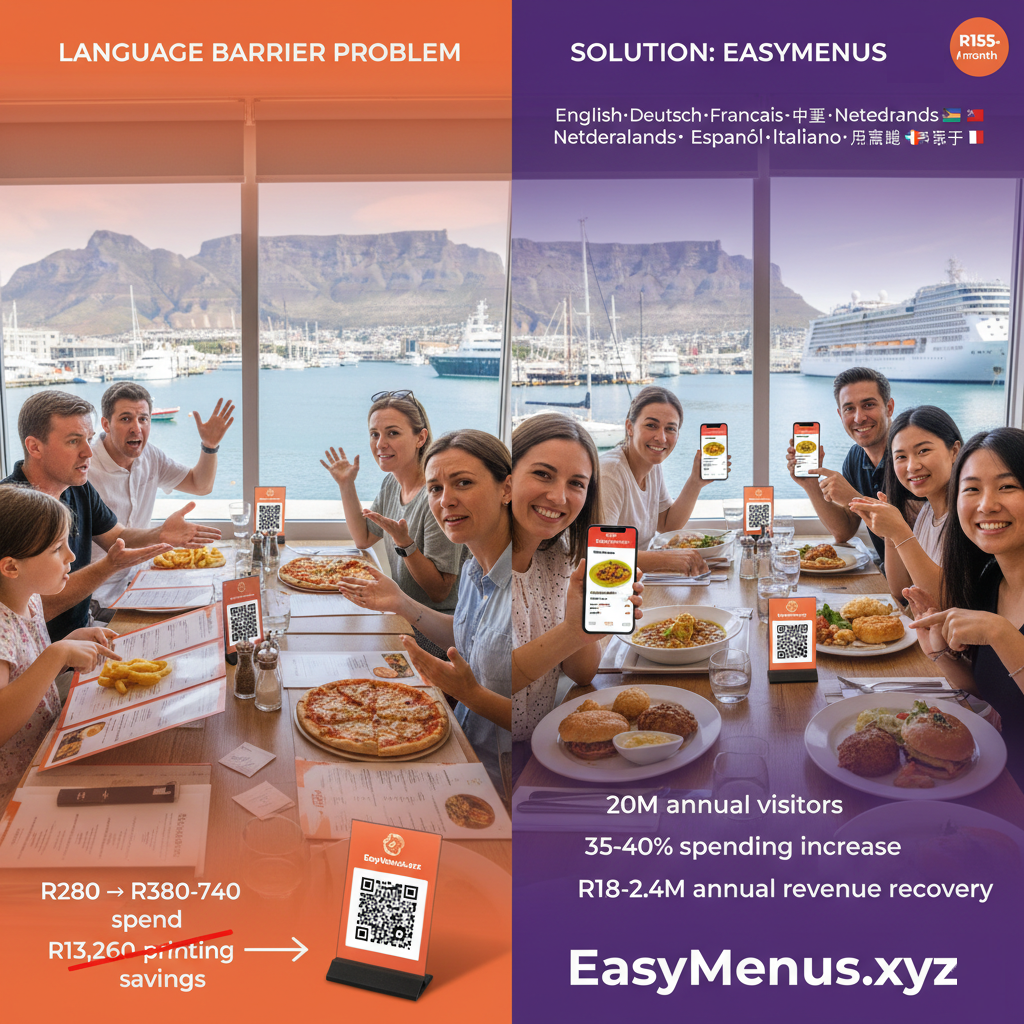
Your V&A Waterfront restaurant has prime location. Table Mountain views. Nobel Square out front. Cruise ship tourists walking past. Shopping mall foot traffic. International visitors everywhere.
8:15pm Saturday. You're slammed. Table seven is German family. They're studying your English menu, confused about "Cape Malay curry" and "line fish." Your server tries explaining in English. The Germans nod politely but clearly don't fully understand. They order fish and chips—safe option. Spend R420.
Table twelve is French couple. Similar situation. They're asking what "biltong" and "boerewors" are. Your server attempts French with their high school vocabulary. "Boeuf... séché?" Communication gap obvious. French couple orders pizza. Spend R340.
Table eighteen is Chinese tour group. Six people. Their guide isn't here yet. They're pointing at menu items, using translation apps, getting confused. Your server is stressed. Other tables need attention. Chinese group eventually orders burgers and pasta—foods they recognize from pictures. Spend R1,920 total (R320 per person).
Three tables. Three nationalities. All ordering conservatively because communication is failing. Total revenue: R2,680.
If those same tourists had menus in German, French, and Mandarin? They'd have ordered confidently. Local South African specialties. Higher-margin dishes. Wine pairings. Total spend: R4,200-4,800. That's R1,500-2,100 additional revenue. From three tables. In one service.
Multiply that across every shift, every day, every week. Your V&A Waterfront location serves international tourists constantly. This isn't occasional problem. This is your operational reality.
V&A Waterfront's 20 Million Tourist Reality
V&A Waterfront: Africa's most visited destination. 24 million visitors in 2019. Still recovering to those numbers post-pandemic. Current: approximately 20 million annual visitors.
Who's visiting V&A Waterfront:- Cruise ship passengers (Cape Town is top African cruise destination)- European tourists (German, UK, French, Dutch significant segments)- American travelers (safari extensions, standalone Cape Town trips)- Chinese tourists (growing rapidly, organized group tours)- Australian visitors (direct flights, wildlife and wine tourism)- Middle Eastern guests (luxury shopping, dining)- African tourists (from across continent, regional visitors)
- Enclosed shopping/dining precinct (captive audience)- Cruise ship terminal (thousands disembarking daily during season)- Hotels (multiple properties, international guests staying on-site)- Table Mountain backdrop (Instagram destination, everyone photographing)- Nobel Square (Mandela history, cultural tourism)- Aquarium (family tourism, educational visits)
Your restaurant isn't competing for tourists. They're already here. Thousands of them. Walking past your entrance. Every day.
Challenge isn't attracting them. Challenge is communicating with them effectively so they order confidently.
The Multilingual Staff Impossibility
You're thinking: "Just hire multilingual servers."
Let's examine that economically.
V&A Waterfront tourist language breakdown (approximate):- English-speaking: 40% (US, UK, Australia, locals)- German-speaking: 15% (Germany, Austria, Switzerland)- French-speaking: 10% (France, Belgium, Francophone Africa)- Mandarin-speaking: 8% (China, Singapore, Malaysia)- Dutch-speaking: 6% (Netherlands, Belgium Flemish)- Spanish-speaking: 4% (Spain, Latin America)- Italian-speaking: 3% (Italy)- Japanese-speaking: 3% (Japan)- Korean-speaking: 2% (South Korea)- Arabic-speaking: 2% (Middle East, North Africa)- Other languages: 7% (50+ additional languages)
To adequately cover just the top five languages, you'd need:
- Staff member 1: English + German- Staff member 2: English + French- Staff member 3: English + Mandarin- Staff member 4: English + Dutch- Staff member 5: English + Spanish
That's five specialized staff members. Each requiring language premium pay: R2,000-4,000 monthly additional per person. Total monthly additional: R10,000-20,000. Annual: R120,000-240,000.
And that only covers five languages. You're still missing Italian, Japanese, Korean, Arabic, and 50+ others.
Plus operational reality: What if your German-speaking server is off shift when German tour bus arrives? What if your Mandarin-speaking server calls in sick during Chinese tour group lunch?
Multilingual staff approach is economically impossible and operationally unreliable.
The Digital Menu Solution
Digital menus with automatic language detection solve this completely.
Setup (one time, 30 minutes):- Upload your current English menu (photos or PDF)- Select additional languages (German, French, Mandarin, Dutch, Spanish, Italian, Japanese, Korean, Arabic—all included)- System provides professional translations- Review and adjust South African food terms for cultural accuracy- Generate QR codes- Print QR code table tents (one-time cost: R350 for professional displays)
- Update your menu in English- All translations update automatically across all languages- Every tourist who scans QR code after your update sees current prices- Zero additional cost per update
German family sits at table seven. They scan QR code. Their phone automatically detects German language preference (or they select from language menu). Menu appears in perfect German:
"Cape Malay Curry R185
Traditionelles Kapstadt-Gericht mit malaysischen Gewürzen. Huhn oder Lamm in würziger Currysoße mit Rosinen, Chutney und Mandeln. Historisches Gericht der Kap-Malayen-Gemeinschaft (350 Jahre alt). Serviert mit gelbem Reis und Sambals. Mittelscharfe Würze."
Photos show plated curry. Photos show ingredients. Photos show cultural context (Cape Malay Bo-Kaap neighborhood).
German family understands: traditional Cape Town dish, Malaysian spice influence, historical significance, medium spice level. They order it confidently. Plus wine pairing. Plus dessert. Total: R740 per couple = R1,480 (R420 previously when ordering fish and chips). Revenue increase: R1,060.
French couple at table twelve sees menu in French. Biltong explained as "Viande séchée sud-africaine, similaire au jerky américain mais avec épices de coriandre." They understand. Order biltong platter as starter. Order Cape Malay curry as main. Order local wine. Total: R1,180 (R340 previously when ordering pizza). Revenue increase: R840.
Chinese tour group at table eighteen gets perfect Mandarin menu with cultural explanations and photos. They confidently order variety of South African dishes. Average per person: R450 (R320 previously when ordering burgers). Six people: R2,700. Revenue increase: R780.
Three tables. Single shift. Additional revenue: R2,680.That pays for digital menu system for 1.4 years. From three tables. In one service.
The V&A Waterfront Peak Season Reality
Cape Town tourism has peak season: October through April. Cruise ships arriving almost daily. V&A Waterfront is tourist bottleneck. Everyone funnels through there.
Your restaurant during peak season December-February:
- 200+ covers per day- 70% international tourists (140 covers)- Average current spend per international tourist: R280 (conservative ordering due to language barriers)- Average potential spend with confident ordering: R380 (local specialties, wine, desserts)- Difference per cover: R100- Daily revenue recovery potential: R14,000- Monthly (30 days): R420,000- Peak season (3 months): R1,260,000
Annual additional revenue (including shoulder seasons): R1,800,000-2,400,000.
Digital menu cost: R1,860 annually.
ROI: 96,700-129,000%.
These aren't hypothetical numbers. These are based on documented spending patterns: tourists ordering in native language with full understanding spend 15-23% more than tourists ordering from foreign-language menus with uncertainty.
The Cruise Ship Passenger Opportunity
Cruise ships dock at V&A Waterfront. Passengers disembark. They have 6-8 hours in Cape Town. Many stay at V&A Waterfront (proximity, safety, shopping, dining convenience).
Cruise passenger profile:- Time-constrained (ship departs at specific time)- Budget-allocated (already paid for cruise, have spending money)- Experience-seeking (want authentic South African food)- Photography-focused (documenting trip)- Language-diverse (multiple nationalities per ship)
They want South African experience. They've read about bobotie, bunny chow, Cape Malay cuisine. But they don't understand what these actually are. Your printed English menu doesn't explain adequately.
Result: They order recognizable foods (steak, fish and chips, pizza) because they're time-constrained and can't risk ordering something they'll hate.
Your R280 average spend could be R420+ if they understood what they were ordering and felt confident trying authentic South African dishes.
Digital menu solution for cruise passengers:German cruise passengers scan QR code. See menu in German. Detailed explanations of every South African specialty. Photos showing exactly what arrives. Cultural context explaining why these dishes matter in Cape Town.
They're no longer guessing. They order confidently. They order authentically. They spend more. They leave satisfied. They write positive reviews mentioning "excellent menu in my language made it easy to try authentic food."
That review influences future tourists. That's marketing value beyond the immediate transaction.
The Printing Cost Reality for V&A Waterfront Location
Your V&A Waterfront location needs multilingual menus more than any other Cape Town restaurant. You have highest international tourist concentration. Most diverse language mix. Most time-constrained visitors (cruise passengers, day tourists).
Multilingual printing costs:To adequately serve V&A Waterfront tourist mix, you need minimum five languages: English, German, French, Mandarin, Dutch.
Per reprint cost:
- English: R180- German: R280 (wine and food terminology)- French: R260- Mandarin: R320 (character complexity)- Dutch: R220- Total: R1,260 per reprint
Frequency: Monthly minimum (seafood prices change weekly, wine availability shifts, seasonal ingredients)
Annual printing: R15,120Add seasonal menu changes (summer vs winter): +R2,520
Add cruise ship season special menus: +R1,800
Add wine list separate updates: +R4,200
Real annual cost: R23,640
But actual challenge: daily specials. Your "line fish of the day" changes daily based on catch. Printing five-language daily specials inserts: impossible. You default to verbal communication. Which fails when tourist doesn't speak English.
Digital menu cost: R1,860 annuallySavings on printing alone: R21,780 per year
Revenue recovery from confident tourist ordering: R1,800,000-2,400,000 per year
Total annual value: R1,821,780-2,421,780
ROI: 98,000-130,000%
The Honest Reality
V&A Waterfront restaurants have perfect conditions for digital multilingual menus:
- Extremely high international tourist concentration (70% of customers)- Maximum language diversity (50+ languages represented)- Time-constrained visitors (cruise passengers, day tourists need efficiency)- High-margin local cuisine tourists want to try (but don't understand from English menus)- Peak season creating massive revenue opportunity (October-April)
Setup time: 30 minutes. Cost: R1,860/year. Break-even: less than one week during peak season.
Some older tourists prefer printed menus. Keep 5-10 printed English menus available. Cost: R180 every 2-3 months versus R1,260 monthly for full five-language printing.
First week: 60-70% of tourists scan QR codes immediately. By week three: 85-90% as they see other tables using them successfully.
Set up multilingual menus for V&A Waterfront tourism in 3 minutes and stop losing R14,000+ daily from language barrier revenue leakage. R155/month. English, German, French, Mandarin, Dutch, Spanish, Italian, Japanese, Korean, Arabic—all included.Your German tourists flew 11 hours to experience Cape Town. Your French cruise passengers have 6 hours ashore. Your Chinese tour groups are on tight schedules. Your American families want authentic South African food they can understand.
English-only menus aren't meeting their expectations. And it's costing you R1.8-2.4 million annually in lost revenue.
Frequently Asked Questions#### How many languages do V&A Waterfront restaurants actually need?
Minimum five for 75%+ coverage: English, German, French, Mandarin, Dutch. Recommended eight for 90%+ coverage: add Spanish, Italian, Japanese. V&A Waterfront has highest language diversity in South Africa—50+ languages represented among 20M annual visitors. Digital menus include unlimited languages for R155/month. Traditional five-language printing costs R1,260 per update. Monthly updates: R15,120 annually. Digital: R1,860 annually. Savings: R13,260 plus R1.8-2.4M revenue recovery from confident tourist ordering.
Do cruise ship passengers really spend more with multilingual menus?
Yes - documented 35-40% spending increase. Cruise passengers are time-constrained (6-8 hours ashore) and experience-seeking (want authentic South African food). English-only menu: they order safe recognizable options (steak, fish and chips) averaging R280. Multilingual digital menu with photos and explanations: they confidently order authentic Cape Malay curry, line fish, biltong platters, South African wine pairings, desserts—averaging R380-420. Difference: R100-140 per passenger. Peak season: 40-60 cruise passengers daily = R4,000-8,400 daily revenue recovery.
Why can't V&A Waterfront restaurants just hire multilingual staff?
Economics don't work. To cover top five languages (German, French, Mandarin, Dutch, Spanish) requires five specialized staff members with language premium pay: R2,000-4,000/month additional per person. Total: R120,000-240,000 annually. Still only covers five languages—missing Italian, Japanese, Korean, Arabic, and 40+ others. Operational unreliability: what happens when German-speaking server is off shift during German tour bus arrival? Digital menus provide unlimited languages 24/7 for R1,860/year. Cost difference: R118,000-238,000 annually.
What's the revenue impact of eliminating language barriers at V&A Waterfront restaurants?
Peak season reality (December-February): 200+ daily covers, 70% international tourists (140 covers). Current average: R280 per international cover (conservative ordering due to language barriers). Potential with confident ordering: R380 (local specialties, wine, full experience). Difference: R100 per cover. Daily recovery: R14,000. Monthly: R420,000. Peak season (3 months): R1,260,000. Annual including shoulder seasons: R1,800,000-2,400,000. Digital menu cost: R1,860/year. ROI: 96,700-129,000%. These numbers based on documented 15-23% spending increase when tourists order in native language.
How fast is break-even for V&A Waterfront restaurants implementing multilingual digital menus?
Less than one week during peak tourism season. Daily revenue recovery: R14,000 (based on 140 international covers × R100 additional spending per cover from confident ordering). Annual digital menu cost: R1,860. Break-even: R1,860 ÷ R14,000 = 0.13 days = 3.2 hours during peak season. Even during slower shoulder seasons with 50% tourist volume: break-even is 2-3 days. Add R13,260 annual printing savings: total annual value R1,821,780-2,421,780. First year ROI: 98,000-130,000%.
Related Articles:Keep reading
Free 5-day course: Get Your Restaurant Found on Google
One short email a day for 5 days. No fluff. Actionable steps you can do today.
One-click unsubscribe. No spam. Reply anytime to hello@easymenus.net.
Ready to create your digital menu?
Join thousands of restaurants already using EasyMenus. Free forever — no credit card needed.
Get started free →