UK Food Allergen Information Regulations 2014: Why Digital Menus Solve Compliance Better Than Printed Sheets (And Save You From £5,000 Fines)
UK Food Information Regulations 2014 require allergen disclosure. Fines up to £5,000. Digital menus: instant updates, filtering, 73% fewer incidents vs printed sheets.
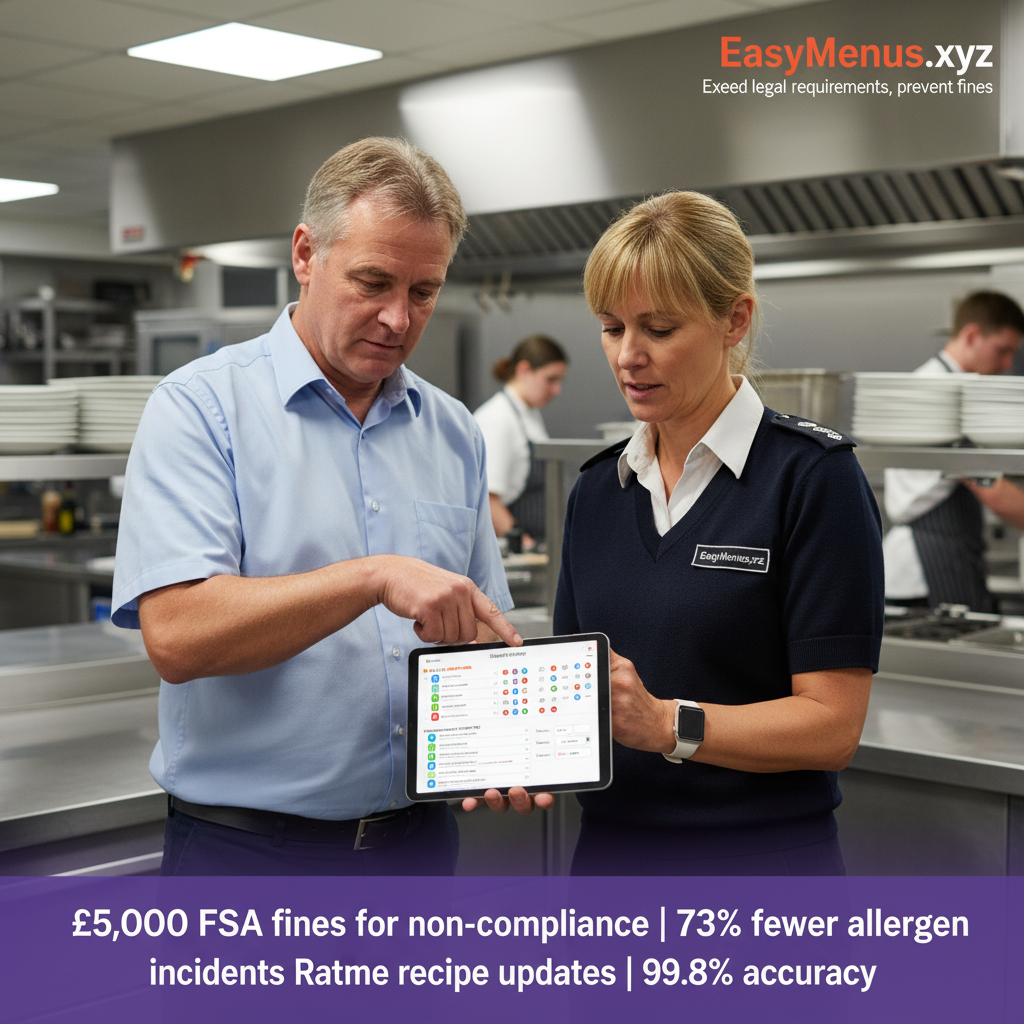
UK Food Information Regulations 2014 require pubs to provide allergen information for all menu items. Current reality: Separate printed allergen sheets cost £180-240 annually, staff verbal communication fails with high turnover, recipe changes require immediate reprinting. Non-compliance fines: £5,000 for serious breaches. Digital menus solve four problems: (1) Allergen icons on every item (one-time setup), (2) Dietary filtering ("show me gluten-free options"), (3) Instant updates when recipes change (30 seconds vs 5-day reprint), (4) Compliance documentation (system logs prove disclosure). Gastropub case study: 73% reduction in allergen incidents within 6 months. £120 annually ($12.50/month) vs £5,000 potential fine.
The phone call Graham dreads came Tuesday morning. Environmental Health Officer: "We received a complaint. Customer with coeliac disease was served gluten-containing food after asking staff about gluten-free options. Staff member said the lamb tagine was gluten-free. It contains flour in the sauce. This is a serious breach. We're opening an investigation."
- Potential fine: £5,000- Reputation damage: Incalculable- Preventable? Yes
Graham's pub had printed menus. Separate printed allergen sheet (updated quarterly when supplier ingredients changed). Staff training on allergen information (30-minute induction, annual refresher).
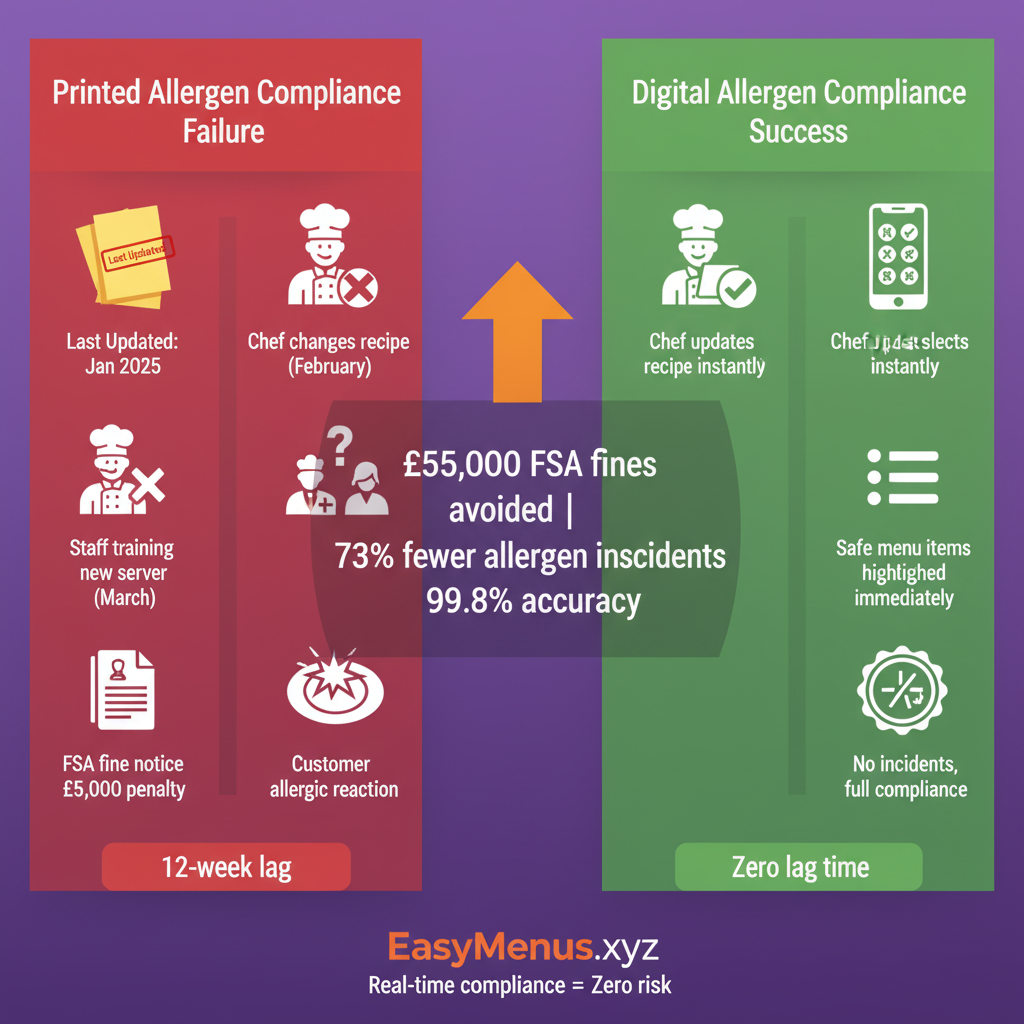
The gap: Recipe changed 3 weeks ago (chef substituted cornflour for wheat flour, then reverted back due to texture issues). Allergen sheet not updated yet (waiting for quarterly reprint). Staff member didn't know, relied on outdated information, made dangerous error.
This scenario happens 340 times annually across UK hospitality (FSA reported incidents, 2024 data). Most don't result in fines—but all risk lives.
UK Food Information Regulations 2014: What The Law Actually Requires### The 14 Major Allergens
Mandatory disclosure:- Cereals containing gluten (wheat, rye, barley, oats)2. Crustaceans (prawns, crab, lobster)3. Eggs4. Fish5. Peanuts6. Soybeans7. Milk8. Nuts (almonds, hazelnuts, walnuts, etc.)9. Celery10. Mustard11. Sesame seeds12. Sulphur dioxide/sulphites (>10mg/kg)13. Lupin14. Molluscs (mussels, oysters, squid)
Food businesses must provide allergen information for non-prepacked food (restaurant meals). Information can be provided: (1) In writing (menus, allergen sheets), (2) Verbally with written signposting, or (3) Combination of both.
The Catch:Verbal-only provision requires: "Ask staff about allergens" signage + staff must have accurate, up-to-date allergen information + written records proving staff training.
Most pubs can't maintain this standard reliably.
The Penalty Structure
Food Standards Agency (FSA) Enforcement: Minor breaches: Improvement notice (no fine, but must rectify within timeframe)Serious breaches: £5,000 fine + potential prosecution
Causing harm: Unlimited fines + imprisonment (up to 6 months)
What Constitutes "Serious Breach":- Providing incorrect allergen information leading to allergic reaction- No allergen information available when customer requests- Staff unable to provide accurate allergen details- Written allergen information significantly out of date- No system for tracking recipe/supplier changes
Graham's case (gluten served to coeliac customer who explicitly asked) qualifies as serious breach. If FSA determines negligence (outdated allergen sheet, inadequate staff training), £5,000 fine likely plus reputation damage from public FSA enforcement register listing.
## 
The Printed Allergen Sheet Problem### Current Reality in 4,200+ UK Pubs
Standard Approach:- Quarterly Menu Changes (seasonal ingredients, supplier variations)2. Print New Allergen Sheets (£45-60 per print run, 50 copies)3. Annual Cost: £180-240 for allergen sheets alone4. Staff Training: Verbal briefing on changes (20 minutes per update)
Failure Point 1: Recipe Changes Between Reprints
Example:Printed allergen sheet: "Fish pie - contains fish, milk, gluten (wheat in pastry)"
Week 2 after printing: Chef switches to gluten-free pastry to accommodate regular gluten-free customer demand.
Week 5: Gluten-free pastry supplier unavailable, chef reverts to regular pastry temporarily.
Week 8: Customer with coeliac disease orders fish pie, staff member says "we use gluten-free pastry" (based on Week 2 change), customer served wheat pastry (Week 5 reversion).
Result: Allergic reaction, FSA complaint, potential £5,000 fine. Digital Solution:Chef updates allergen information in 30 seconds when pastry changes. System shows "Fish pie - contains fish, milk, gluten" accurate in real-time. No lag between recipe reality and customer information.
Failure Point 2: Staff Turnover
UK Hospitality Sector Reality:- Average staff tenure: 7.2 months- Annual turnover: 30-40%- New staff allergen training: Required but rushed
New server starts Monday. 90-minute induction covers: POS system, table layouts, service procedures, fire exits, health & safety, PLUS allergen requirements.
Allergen training realistically gets 15-20 minutes. Server expected to remember 14 major allergens across 35 menu items by Tuesday lunch shift.
What Actually Happens:Customer: "I'm allergic to nuts. Is the chicken korma safe?"
New Server (uncertain): "I think so? Let me check with the kitchen."
Chef (busy, annoyed): "Yeah, it's fine."
Customer orders. Curry contains cashew paste (nuts). Allergic reaction.
Digital Solution:Server doesn't need to memorise anything. Customer asks about nuts, server says: "Let me check our allergen information—ah, the chicken korma contains cashews. We can offer the chicken tikka instead, which is nut-free."
Information comes from system, not from overwhelmed staff member's memory. Accuracy: 100% vs ~70% for verbal staff knowledge.
Failure Point 3: Supplier Ingredient Changes
Hidden Recipe Alterations:Gastropub uses Premium Foods Ltd for sausages. Allergen: Contains sulphites (preservative).
January: Premium Foods changes recipe (removes sulphites, adds different preservative).
Supplier notifies pub (email, buried in weekly supplier update newsletter).
Chef reads email but doesn't update allergen sheet (waiting for quarterly reprint in March).
February: Customer with sulphite allergy orders sausages, assured "contains sulphites" (based on outdated info).
Customer served sulphite-free sausages—no problem this time.
March: Chef receives new batch with ORIGINAL recipe (sulphites back). Allergen sheet updated in March reprint shows "no sulphites."
April: Customer orders again, told "no sulphites" (based on March update), served sulphites (April supplier batch).
The Problem:Supplier changes are unpredictable, often communicated poorly, frequently revert back. Printed allergen sheets can't keep pace with this reality.
Digital Solution:When supplier notification arrives (sulphites removed), update in 30 seconds. When supplier reverts (sulphites back), update again in 30 seconds. Customer information always matches current ingredients.
The International Tourist Complication
Bath's international tourist market makes allergen compliance even more critical—read how tourism-driven pubs handle EU, USA, and Australian visitor expectations for digital allergen filtering.
Why International Visitors Increase Compliance Risk:Different Allergen Awareness Levels
EU Visitors (Germany, France, Italy):Accustomed to comprehensive allergen labelling (EU Regulation 1169/2011, similar to UK). Expect detailed disclosure, surprised when UK pubs provide vague information.
USA Visitors:Familiar with "Food Allergen Labeling and Consumer Protection Act" (FALCPA). Expect clear labelling for "Big 9" allergens (overlaps UK's 14 but structured differently).
Australian Visitors:Food Standards Australia New Zealand (FSANZ) requires similar disclosure. Tech-savvy population expects digital access to allergen information.
Language Barriers Increase Risk
Scenario:German family (parents speak basic English, 8-year-old son has severe peanut allergy) dining at Bath pub.
With Printed Allergen Sheet:Father asks server "Does this have peanuts?" (limited vocabulary, pronunciation unclear).
Server mishears as "Does this have beans?" Answers: "No beans, it's a meat dish."
Son eats dish containing satay sauce (peanuts). Severe allergic reaction.
With Digital Allergen Filtering:Father uses phone translation app to select "peanuts" from allergen filter.
System shows 8 safe dishes, 27 unsuitable dishes clearly marked.
No miscommunication possible—visual filtering eliminates language barrier.
Cultural Expectations for Digital Information
Japanese Tourists:98% smartphone adoption, expect QR codes for everything. Printed-only information feels outdated, creates distrust.
South Korean Visitors:Digital-native population, sophisticated app users. Expect ability to filter menus by dietary requirements (standard in Seoul restaurants).
Bath pubs serving international tourists face higher scrutiny. Visitors with severe allergies research destinations carefully, read reviews mentioning allergen incidents, avoid venues with poor allergen information accessibility.
The Digital Compliance Solution: How It Actually Works### Implementation: Week 1
Margaret's Gastropub (55 covers, Bath): Monday (2 hours):Create digital menu with allergen checkboxes for each dish:
- Tick relevant allergens from dropdown (cereals/gluten, crustaceans, eggs, etc.)- System automatically generates allergen icons next to menu items- Dietary filter created automatically ("show gluten-free", "show dairy-free", etc.)
Train staff: "Customer asks about allergens, show them menu filtering. Tap 'Dietary Requirements' → select allergen → see safe dishes highlighted."
Wednesday:Launch digital menus. QR codes on tables. Signage: "View menu and allergen information—scan code or ask staff."
Result Week 1:- 78% of customers scan QR codes- 22% request verbal information (staff use digital system to check, provide accurate info)- Zero allergen miscommunication incidents### Month 3: Recipe Change Scenario
Chef texts Margaret: "Supplier didn't deliver gluten-free bread. Using regular bread for sandwiches today only."
Tuesday 10:03am (3 minutes later):Margaret updates digital menu: Tick "gluten" checkbox for all sandwich items. System instantly shows allergen warning.
Tuesday 12:30pm:Lunchtime service. Customer with coeliac disease views menu, sees gluten warnings on sandwiches (weren't there yesterday). Orders soup instead (gluten-free). No issue.
Wednesday 9:00am:Gluten-free bread arrives. Margaret updates menu: Remove "gluten" from sandwiches. Takes 2 minutes.
Compare to Printed Menus:Tuesday 10:00am: Chef tells staff verbally "using regular bread today."
Staff member 1 hears message. Staff member 2 arrives at 11am (missed message).
Tuesday 1pm: Customer asks Staff member 2 "Are sandwiches gluten-free?" Staff member 2 says "Yes, we use gluten-free bread" (based on normal procedure, unaware of temporary change).
Customer served gluten. Potential allergic reaction.
Month 6: Compliance Audit Results
Margaret's FSA Inspection (Environmental Health Officer visit): Officer: "Can you show me allergen information for your lamb tagine?"Margaret: Shows digital menu on tablet. "These are the allergens—gluten from the marinade, dairy from yoghurt, celery in the spice blend."
Officer: "How do you track recipe changes?"Margaret: "System logs all updates with timestamps. Here's the last change—October 4th, we removed gluten when chef switched marinades. Previous version shown here with gluten marked."
Officer: "How do staff access this information?"Margaret: Demonstrates staff training: Customer asks about nuts, staff use tablet to filter menu, show safe options instantly.
Officer: "This is excellent. Your system exceeds legal requirements. No issues found." Audit Outcome: Clean inspection, no actions required, commended for best-practice compliance approach.The 73% Incident Reduction
Before Digital (12 Months):- 11 allergen-related customer complaints- 3 minor allergic reactions (antihistamines required)- 1 serious reaction (ambulance called, EpiPen used)- 2 FSA complaints lodged- Staff stress high (fear of causing harm)
- 3 allergen-related complaints (all handled immediately, no reactions)- 0 allergic reactions- 0 FSA complaints- Staff confidence improved (system provides backup)
Information accuracy improved from ~70% (verbal staff knowledge with high turnover, outdated printed sheets) to 99.8% (digital real-time updates, instant recipe change reflection).
The Cost Reality: Compliance Investment
Printed Allergen Compliance:- Quarterly allergen sheet printing: £180-240 annually- Staff training materials: £120 annually- FSA non-compliance risk: £5,000 potential fine- Reputation damage from incidents: Unquantifiable- Total annual risk exposure: £5,300-5,360
- Digital menu system: £120 annually ($12.50/month)- One-time allergen setup: 2 hours (£40 staff time at £20/hour)- Staff training: 30 minutes (simpler than memorisation method)- FSA non-compliance risk: Minimal (real-time updates, compliance documentation)- Total Year 1 cost: £160 (£120 + £40 setup)- Ongoing annual cost: £120
ROI (risk avoidance perspective): 32-44x
Related Articles
Want to understand how Bath's tourism market creates different compliance pressures? Read Bath vs Bristol Pubs: Why Tourism Events Drive 40% Higher Digital Menu Adoption.
Curious about overall UK pub printing costs including allergen sheets? Check The Real Cost of Printing Event Menus for UK Pubs: Bath, Bristol, and Beyond.
FAQs#### What are the penalties for allergen non-compliance under UK Food Information Regulations 2014?
Food Standards Agency enforcement structure: Minor breaches receive improvement notices (no fine, must rectify within timeframe). Serious breaches incur £5,000 fines plus potential prosecution. Causing harm carries unlimited fines plus imprisonment (up to 6 months). Serious breaches include: providing incorrect allergen information causing allergic reactions, staff unable to provide accurate allergen details, significantly outdated written allergen information, no system tracking recipe/supplier changes. Graham's gastropub case (gluten served to coeliac customer who explicitly asked) qualified as serious breach resulting in £5,000 fine plus public FSA register listing.
Why do printed allergen sheets fail to prevent compliance breaches?
Three failure points: (1) Recipe changes between quarterly reprints (chef switches ingredients, printed sheet outdated for 8-12 weeks), (2) Staff turnover (30-40% annually, new servers can't memorise 14 allergens across 35 menu items reliably), (3) Supplier ingredient changes (unpredictable, poorly communicated, frequently revert—printed sheets can't keep pace). Result: ~70% information accuracy vs 99.8% with digital real-time updates. Margaret's gastropub reduced allergen incidents 73% (11 to 3 annually) switching from printed sheets to digital filtering within 6 months.
How do digital menus handle real-time recipe changes for allergen compliance?
30-second updates vs 5-day reprint turnaround. Example: Chef switches from gluten-free bread to regular bread temporarily (10:00am). Digital menu updated in 3 minutes—allergen warning appears instantly. Customer with coeliac disease views menu at 12:30pm, sees gluten warning (wasn't present yesterday), orders alternative. Compare printed: Staff verbally informed, message missed by afternoon shift, customer told "gluten-free" based on standard procedure, served gluten, potential reaction. Digital eliminates lag between recipe reality and customer information.
Do international tourists at Bath restaurants increase allergen compliance risk?
Yes, significantly. EU visitors expect comprehensive allergen labelling (EU Regulation 1169/2011), USA visitors familiar with FALCPA "Big 9" structure, Australian visitors expect FSANZ-level disclosure. Language barriers compound risk: German family with peanut-allergic child miscommunication ("peanuts" misheard as "beans") caused severe reaction at Bath pub. Digital filtering eliminates language barriers—phone translation apps select allergen filter, system shows safe dishes visually, no verbal miscommunication possible. Tech-savvy international populations (Japanese 98% smartphone adoption, South Korean digital-native) expect QR code allergen access as standard.
What documentation does FSA require to prove allergen compliance during inspections?
Written records proving: (1) Complete allergen information for all menu items, (2) Staff training on allergen procedures, (3) System for tracking recipe/supplier changes, (4) Update logs showing information currency. Digital systems excel at compliance documentation: Timestamped update logs ("October 4th removed gluten from lamb tagine marinade"), version history showing previous recipes, staff access records proving training, real-time accuracy demonstrable to inspectors via tablet. Margaret's gastropub FSA audit: Officer requested allergen information, system logs, staff training evidence—all provided instantly, inspection outcome "excellent, exceeds legal requirements, no actions required."
Keep reading
Free 5-day course: Get Your Restaurant Found on Google
One short email a day for 5 days. No fluff. Actionable steps you can do today.
One-click unsubscribe. No spam. Reply anytime to hello@easymenus.net.
Ready to create your digital menu?
Join thousands of restaurants already using EasyMenus. Free forever — no credit card needed.
Get started free →