Rotterdam Restaurants: Why Digital Adoption Accelerates 2026-2028
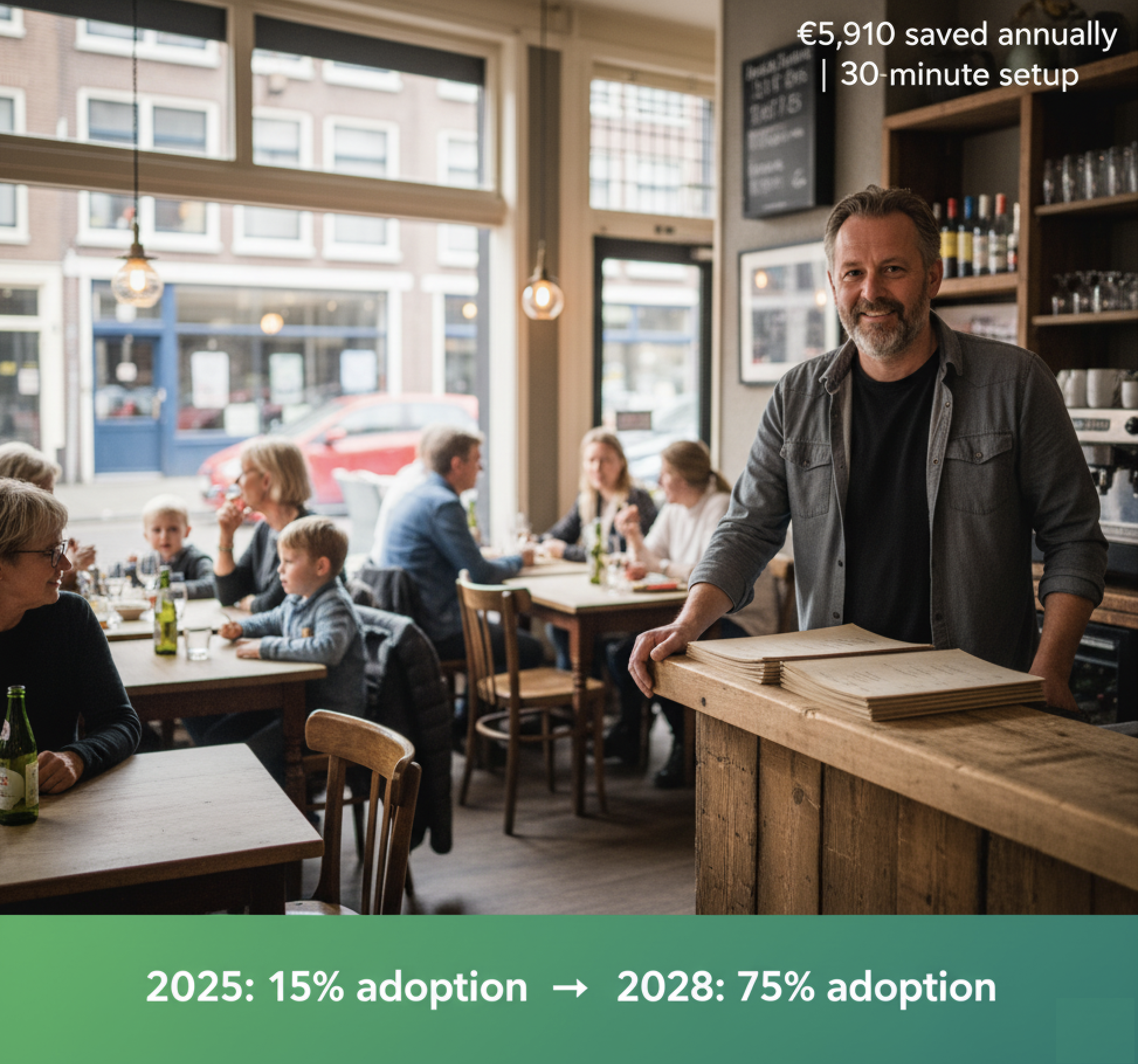
Rotterdam restaurants save €5,910 annually on digital menus. Adoption accelerates 15% (2025) to 75% (2028). Cost of waiting: €18,000-24,000 lost.
The Rotterdam Reality
Your neighbourhood restaurant in Witte de Withstraat or Oude Haven isn't feeling pressure to adopt digital menus. Yet.
Your customers are locals—Dutch families, Turkish regulars, Surinamese communities. They know your menu. They speak Dutch or adequate English. Traditional printed menus work adequately for established operations.
But the economics don't lie: You're spending €5,000-8,000 annually on printing versus €150 for digital. That's €4,850-7,850 wasted yearly. The timeline: Rotterdam adoption will accelerate from 15% (2025) to 75% (2028) as competitive pressure builds and neighbourhood gentrification brings digital-expecting customers. Early adopters capture €18,000-24,000 in savings before market forces adoption anyway. Critical mass moment: 2027. When 50%+ of your commercial street offers QR menus, customer expectations flip from "nice option" to "expected standard." Start 3-minute setup—capture savings before competitive pressureWhy Rotterdam Moves Slower Than Amsterdam (But Faster Than You Think)### The Neighbourhood Restaurant Advantage
Bistro Rotterdam Zuid serves primarily local customers in Feijenoord. Tuesday dinner service includes Dutch families who've been coming for years, Turkish regulars who order the same dishes, Surinamese friends celebrating birthdays.
This is fundamentally different from Amsterdam's tourist chaos.Your customers:
- Know your menu by heart- Speak Dutch or adequate English- Return weekly or monthly- Appreciate consistency over variety- Accept traditional Dutch hospitality norms
This creates different urgency. Amsterdam restaurants feel immediate pressure from tourist operations. Rotterdam restaurants see the logic but don't feel same necessity.
Yet.The Quiet Economic Waste
Restaurant Ouwe Hoer in Oude Haven has operated since the neighbourhood was rebuilt post-WWII. They serve Dutch classics to Rotterdam families, port workers, Dutch pensioners.
They reprint menus 2-3 times yearly for seasonal adjustments (asparagus season, herring season) and occasional price updates.
Annual printing: €5,300- Main menus (Dutch, some English): €4,200- Wine updates: €320- Seasonal specials: €780
The Rotterdam Adoption Timeline: 2025-2028### Current State (2025): Early Adopter Phase
Rotterdam adoption: 15-20%Amsterdam adoption: 40-45%
Who's adopting now:- Witte de Withstraat trendy establishments serving young professionals and creative class- Katendrecht venues attracting gentrification demographics- Fenix Food Factory and similar operations serving tourists alongside locals- Restaurants opened in last 2-3 years by younger operators comfortable with digital
- Traditional neighbourhood establishments with older owner-operators- Family restaurants serving established communities- Venues where "printing works fine" and change feels unnecessary
2026 (12-18 Months): Acceleration Begins
Expected Rotterdam adoption: 30-35%Expected Amsterdam adoption: 65-75%
What changes: Competitive pressure intensifies: When 7-8 restaurants per commercial street block offer QR menus in Witte de Withstraat, the 2-3 still printing start looking outdated. Neighbourhood gentrification accelerates: Rotterdam's working-class areas (Katendrecht, Noord, Charlois) are gentrifying with young professionals, creative industries, startup culture. These demographics expect digital convenience and notice when restaurants don't offer it. Amsterdam spillover effect: Rotterdam operators visiting Amsterdam notice universal QR implementation. Dutch hospitality culture values peer learning—Rotterdam restaurateurs see Amsterdam counterparts saving €10,000+ annually and start questioning their own printing waste. Customer expectations begin shifting: Rotterdam customers increasingly expect the same digital sophistication in restaurants that they experience in every other service—banking, healthcare, government, retail all operate digitally. Restaurants become the outlier.2027 (24-30 Months): Critical Mass Moment
Expected Rotterdam adoption: 50-55%Expected Amsterdam adoption: 85%+
This is when expectations flip.When half of Rotterdam restaurants in trendy districts offer QR menus, the market expectation shifts from "nice option" to "expected standard."
What happens: Customer questions intensify: "The restaurant on Witte de Withstraat has QR menus, why don't you?" becomes common feedback. Not complaints—just observations that your operation appears behind peers. Review mentions increase: Google and TripAdvisor reviews start noting lack of digital menus not as deal-breakers but as signals restaurant is "traditional" or "old-fashioned." For some customers this is positive (authentic, classic), for others negative (behind times, inconvenient). Dutch restaurant associations promote digital: Horeca Nederland and similar industry groups start promoting digital menus as "industry standard," creating social proof pressure that accelerates adoption beyond individual restaurant economics. New restaurant openings default to digital: Restaurants opening in 2027+ launch with digital menus from day one because it's standard practice, not innovative choice. This further normalizes digital as baseline expectation.2028 (36-42 Months): Universal Expectation Phase
Expected Rotterdam adoption: 70-75%Expected Amsterdam adoption: ~90%
Digital menus become assumed standard even in traditional Rotterdam neighbourhood establishments. What changes: The question flips: Instead of "Why should I adopt QR menus?" Rotterdam operators ask "Why am I still paying €6,000/year for printing when everyone else solved this?" Late adopters face higher switching costs: While setup remains technically simple (30 minutes), the psychological cost increases. Early adopters positioned themselves as modern and efficient. Late adopters look like they were forced to catch up rather than making strategic choice. Cost of waiting becomes clear: Restaurant that waited from 2025 to 2028 spent €18,000-24,000 on printing during those three years before switching. Early adopter captured those savings and reinvested in menu quality, staff training, or marketing.Rotterdam catches up to where Amsterdam is today.
What Rotterdam Restaurant Owners Actually Experience### Bistro Feijenoord: The "Eventually" Trap
Traditional Dutch-Surinamese restaurant serving locals. Owner recognizes digital menus would save €5,300 annually. Customers (mostly 40-65 year old Dutch residents) increasingly use smartphones for everything.
Current thinking: "We'll adopt eventually. Just not urgent right now. Printing works fine. Our customers aren't demanding it." Economic reality: Every month delayed costs €440 in avoidable printing expenses. Every year delayed costs €5,300 that could improve operations or owner take-home.Three-year delay costs: €15,900 left on table before switching.
The "eventually" trap: It always feels like "eventually" makes sense, but "now" doesn't feel urgent. Meanwhile thousands of euros accumulate in waste.Restaurant Fitzgerald (Witte de Withstraat): The Modern Operator
Modern international restaurant serving Rotterdam's emerging creative class—young professionals, artists, designers. Already has sophisticated online presence—Instagram, reservations, customer database.
But menus? Still printed.
The disconnect: Everything about their operation is digital except the menu. They want to offer weekly rotating small plates to attract repeat customers. They want to highlight seasonal Dutch ingredients immediately when deliveries arrive. They want detailed wine pairing suggestions that change with menu offerings. All of this is possible digitally, difficult with printing.They know this. They've researched options. They've received quotes. It's on the "to-do list."
The challenge: Not cost (they understand the savings) or capability (they're tech-comfortable). It's organizational inertia. They're busy, printing works adequately, and digital feels like a project rather than immediate necessity. The opportunity cost: While they deliberate, they miss revenue from repeat customers who'd return for weekly specials, miss operational efficiency from instant updates, miss €4,800 annually wasted on printing.Bazar Rotterdam (Katendrecht): Waiting for Perfect
Turkish-Middle Eastern restaurant with interior design as attraction. Serves multicultural Rotterdam communities alongside tourists discovering the neighbourhood.
Their customers increasingly expect digital sophistication. But Bazar wants digital menus that match their quality standards—elegant, refined, sophisticated.
They've seen basic QR implementations that feel cheap and rejected them. They're waiting for digital solutions that meet their brand expectations.
This is Rotterdam's advantage and disadvantage: Rotterdam restaurants can afford to wait, evaluate options, choose carefully. Amsterdam restaurants need multilingual functionality today, can't wait for perfect. But "waiting for perfect" has a cost: €6,500 annually in printing waste while searching for ideal solution. Two-year wait costs €13,000 before implementation.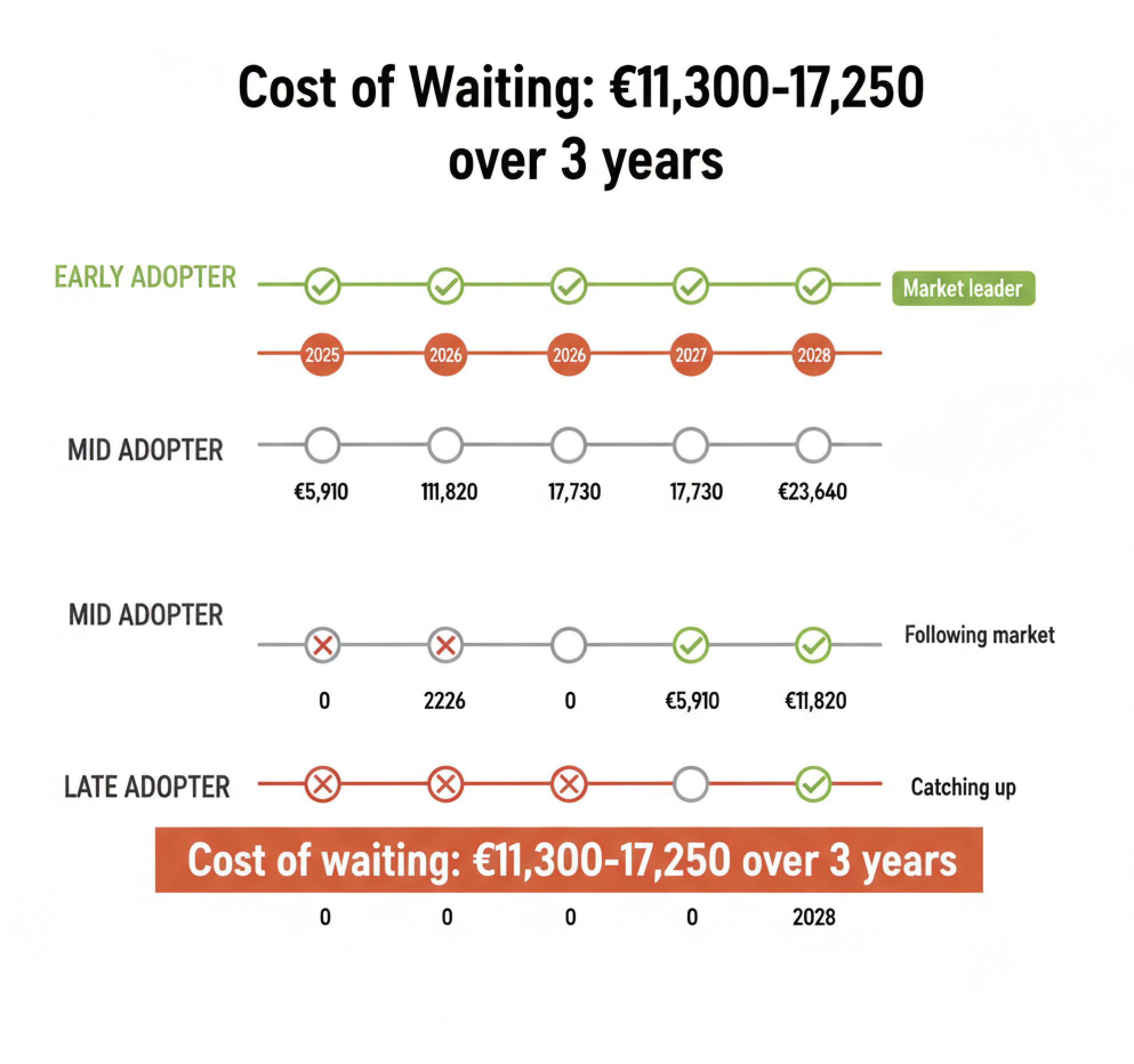
The Real Cost of Waiting: A 3-Year Analysis
Scenario: Rotterdam Neighbourhood Restaurant
Annual printing costs: €5,900Digital menu cost: €150
Early adopter (switches 2025):- 2025 savings: €5,750- 2026 savings: €5,750- 2027 savings: €5,750- 3-year total: €17,250 saved- Position: Market leader, ahead of competitive pressure
- 2025: €5,900 wasted on printing- 2026: €5,900 wasted on printing- 2027 savings: €5,750- 3-year total: €5,950 saved (€11,300 less than early adopter)- Position: Following market, catching up to peers
- 2025: €5,900 wasted- 2026: €5,900 wasted- 2027: €5,900 wasted- 2028 savings: €5,750- 3-year total: €0 saved (€17,250 less than early adopter)- Position: Behind market, perceived as "finally catching up"
Why Rotterdam Economics Are Identical to Amsterdam
Yes, Rotterdam has different operational pressures than Amsterdam:
- Lower tourist intensity (2-3 tourists per resident vs 10:1 Amsterdam)- Less multilingual necessity (Dutch with some English vs 3-5 languages)- Established neighbourhood clientele (locals vs transient visitors)- Traditional Dutch service expectations (familiarity vs digital novelty)
- Prints Dutch menus: €4,480 annually- Wine updates: €640- Seasonal changes: €780- Allergen sheets: €160- Total: €6,060 annually
Your customers don't care that your menu is printed. They care that it's accurate, clear, reflects what you're actually serving. Digital delivers that more reliably than printing.
Common Questions: What Rotterdam Owners Actually Ask### My customers are older Dutch locals—will they use QR codes?
Yes. Netherlands created universal QR literacy through government policy: DigiD government services (2020-present): Every Dutch resident scans QR codes monthly for taxes, healthcare, municipal services, benefits. Even 75-year-old pensioners use DigiD regularly. COVID contact tracing (2020-present): Mandatory QR scanning for venue entry trained entire Dutch population. Real Rotterdam data: Bistro Rotterdam Zuid owner worried about customers averaging 55-70 years, traditional working-class Dutch. Expected pushback. Reality: 91% adoption within first month.Owner's conclusion: "I underestimated Dutch digital comfort. Even our oldest customers scan QR codes for DigiD government services—adding restaurant menus wasn't new technology. It's just another QR code application they already understand."
Dutch customers aged 56-70 show 91% QR adoption—dramatically higher than equivalent US (67%) or UK (71%) demographics because government services created universal familiarity.
When is the "right time" to switch?
Honest answer: Yesterday.Every month you delay costs €420-650 in avoidable printing expenses. Early adoption captures maximum savings and positions you ahead of competitive pressure rather than reacting to it.
Psychological timing:- 2025 (now): You're an early adopter, ahead of market- 2026: You're following best practices, smart operator- 2027: You're catching up to peers, reacting to market- 2028: You're late, forced by customer expectations
Setup takes 30 minutes regardless of when you do it. Savings accumulate immediately. There's no strategic advantage to waiting.
Can't I just reduce printing frequency instead of switching to digital?
You can, but the economics don't improve.Printing less frequently means:
- Longer periods with outdated prices (absorbing supplier increases or disappointing customers with verbal price corrections)- Missed opportunities to highlight seasonal ingredients- Wine lists showing unavailable selections- Customer frustration with inaccurate information
- Servers spend extra time explaining price changes verbally- Customers disappointed by unavailable items don't return- You miss revenue from seasonal specials you can't promote properly- Outdated allergen information creates legal risk
Digital solves the root problem: Your menu is a living document that changes constantly. Printing is fundamentally mismatched to this reality. Reducing printing frequency doesn't fix the mismatch—it just reduces how often you acknowledge it.
What if my competitors don't switch—will I look out of place?
Your competitors will switch. The timeline shows Rotterdam reaching 70-75% adoption by 2028. Current situation (2025): Being an early adopter makes you look modern and efficient. Your digital-expecting customers appreciate it. Traditional customers don't notice or care (91% use QR codes without hesitation). 2026-2027: You'll have plenty of company as adoption accelerates to 30-50%. You'll look like a smart early mover, not an outlier. 2028+: If you haven't switched, you'll be the outlier. Customers will notice you're behind peers. Risk of early adoption: Nearly zero. Worst case: 8-10 customers prefer printed backup menus, which you keep available for €140 one-time cost. Risk of late adoption: €18,000-24,000 wasted on printing over three years + perception of being behind market.What To Do Next: Rotterdam Action Plan### Step 1: Acknowledge the Economics
Your annual printing costs: €_____
Even if you're conservative (€5,000-6,000), you're wasting that money annually when digital costs €150. This isn't about Amsterdam's tourism problems. This is about Rotterdam restaurants unnecessarily spending thousands on printing that solves nothing digital doesn't solve better.Step 2: Recognize the Timeline
2025 (now): 15-20% Rotterdam adoption. You're an early adopter. 2026: 30-35% adoption. Early adopter window closing. 2027: 50-55% adoption. Critical mass reached, market expectation shifts. 2028: 70-75% adoption. Late adopters catching up, forced by customer expectations. Every year you wait costs €5,000-8,000 in printing waste before switching anyway.Step 3: Calculate Your Three-Year Cost
If you switch in 2028 instead of 2025:
Printing waste 2025-2027: €_____ × 3 years = €_____ Savings if you switched today: €_____ - €450 (3 years digital) = €_____ That's money leaving your business unnecessarily.Step 4: Start the 30-Minute Process
Start your 3-minute setup → Photograph menu (10 minutes) → Email to EasyMenus → Receive preview (24 hours) → Approve → Operational (Day 4) Break-even: 7-11 days of operation. By Month 2, you've recovered setup time investment and entered pure savings mode.The Bottom Line for Rotterdam Restaurants
Rotterdam adoption will accelerate from 15% (2025) to 75% (2028). This isn't speculation—it's how technology adoption works when economic benefits are clear and customer expectations shift.
You have three choices:- Adopt now (2025):- Capture €17,000-24,000 in 3-year savings- Position as modern, efficient operator- Ahead of competitive pressure1. Adopt at critical mass (2027):- Capture €6,000-8,000 in partial savings- Follow market standards- Reacting to peer adoption1. Adopt late (2028+):- Capture minimal savings after years of waste- Perceived as "finally catching up"- Forced by customer expectations
The economics don't care about Amsterdam vs Rotterdam operational differences. €5,000-8,000 wasted annually is identical waste regardless of tourist intensity.
Rotterdam restaurants can afford to wait. But waiting costs €420-650 monthly in unnecessary printing expenses while early adopters capture savings and competitive positioning.
Related Articles:Free 5-day course: Get Your Restaurant Found on Google
One short email a day for 5 days. No fluff. Actionable steps you can do today.
One-click unsubscribe. No spam. Reply anytime to hello@easymenus.net.
Ready to create your digital menu?
Join thousands of restaurants already using EasyMenus. Free forever — no credit card needed.
Get started free →