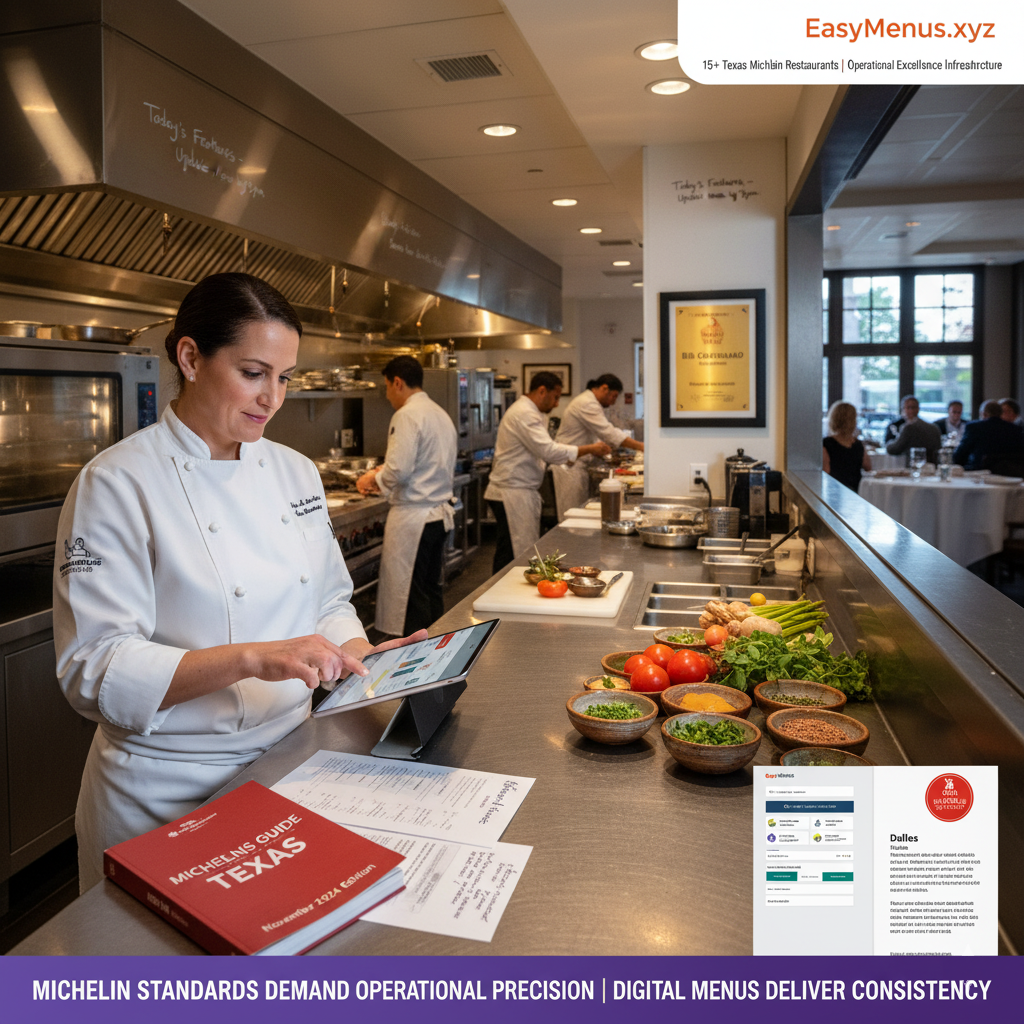
Texas Michelin Guide (Nov 2024) drives Dallas restaurants to adopt digital menus for operational precision. 15+ Bib Gourmand venues, consistency requirements, real-time accuracy standards.
November 12, 2024. Texas's first Michelin Guide launches. Dallas receives 15+ Bib Gourmand recommendations and multiple Michelin-recommended designations. Your restaurant made the list.
You're celebrating. Your team earned this. Years of dedication, seasonal ingredient sourcing, technique refinement, hospitality excellence.
Then reality hits. Michelin isn't a one-time award. It's an ongoing evaluation system. Inspectors return. Standards must be maintained. Operational precision becomes non-negotiable.
Including menu accuracy.
Here's what Dallas fine dining restaurants discovered post-Michelin: operational standards required by the Michelin Guide extend far beyond food quality. Consistency matters. Service precision matters. Menu accuracy matters. Real-time information matters.
Traditional printed menus with 3-7 day update lags can't deliver Michelin-level operational precision. Digital menus can.
This is how Dallas's Michelin-recognized and Michelin-aspiring restaurants use digital menus to support operational excellence standards the guide requires.
Most restaurant operators understand Michelin evaluates food quality. Fewer understand how deeply inspectors assess operational excellence.
The Michelin evaluation framework includes:Michelin inspectors return to restaurants multiple times before awarding recognition. They return after awarding to verify standards maintenance. Consistency across visits is critical.
Traditional menu management creates consistency challenges: Scenario: Spring to Summer TransitionMay visit: Inspector orders "Spring English Pea Agnolotti with Mint, Pecorino, Lemon" – exceptional dish, perfect execution.
July return visit: Inspector orders same dish from printed menu. Server: "Actually, we're now doing summer heirloom tomato version, English peas are out of season."
Inspector's perspective: Menu showing unavailable dish indicates operational imprecision. Why is spring dish still printed in July? Staff having to verbally correct suggests management oversight gap.
Digital menus solve this:May: Spring pea agnolotti on menu, available, accurately described.
Mid-June: Peas no longer peak quality. Remove spring pea dish, add summer tomato version. Update takes 2 minutes. Done.
July inspector visit: Sees current summer menu. Orders tomato agnolotti. Receives what menu describes. Consistency achieved.
Michelin-level dining operates on precision. When menu shows ingredient, technique, sourcing – information must be accurate.
Example from Uchi Dallas:Digital menu entry: "Scottish Salmon Tartare, Sesame Oil, Ponzu, Microgreens, Sustainable Wild-Caught"
This specific. This detailed. This committed.
What happens when Scottish salmon allocation doesn't arrive Tuesday as expected?
Traditional printed menu problem: Menu still shows Scottish salmon. Options: Tell every table "actually, tonight we have Norwegian salmon" (undermines printed menu credibility), or don't serve the dish (disappointing customers who chose restaurant specifically for that preparation). Digital menu solution: Tuesday morning, supplier calls – Scottish salmon delayed. Update menu: "Norwegian Salmon Tartare, Sesame Oil, Ponzu, Microgreens, Sustainable Farm-Raised." Accurate sourcing. Honest preparation. Tuesday dinner, every guest sees current reality. Michelin inspector visits Tuesday? Sees operational precision and transparency.Tyson Cole's Dallas outpost. Omakase program. Daily fish from Tokyo's Toyosu Market. Wine and sake program complexity.
Michelin operational challenges:Elias Pepe's seasonal Italian. Weekly tasting menu changes. Local Texas farm sourcing. Wine program featuring small producers.
Michelin operational challenges:Dallas fine dining operates at $140-$200+ per person average. Michelin Bib Gourmand specifically recognizes "good food at moderate prices" but moderate is relative. In Dallas Uptown fine dining, $140 feels moderate.
At this price point, guests expect operational perfection. Menu accuracy isn't nice-to-have. It's baseline requirement.
What happens when $140 dining has menu inaccuracies:Guest orders wine pairing listed at $95. Server returns: "Actually that wine sold out, similar option is $110." Guest agreed, but mentally noted: At $140 per person, they can't keep wine list current?
Guest asks about allergens. Server: "Let me check with kitchen." Returns 5 minutes later with answer. Guest mentally noted: This information should be instantly available.
Guest orders featured dish from menu. Server: "Chef changed preparation today, now using different technique." Guest mentally noted: Menu shows one thing, restaurant serves another.
Individually, minor issues. Collectively, they create perception of operational imprecision at price point where precision is expected.
Digital menus eliminate these $140 price point concerns:Michelin recognized this. Operational precision at fine dining price points separates good restaurants from Michelin-quality establishments.
Texas fine dining serves corporate expense accounts, international travelers, health-conscious professionals. Allergen information isn't convenience. It's liability protection and Michelin service standard.
Michelin expects detailed allergen accuracy:Dallas corporate clients specifically mention allergen access as reason for choosing Michelin-recognized restaurants. Company liability concerns demand accurate dietary information. Digital menus deliver this while maintaining fine dining aesthetic.
Not every Dallas restaurant received Michelin recognition in 2024. But many are positioned for future recognition. These aspiring establishments study Michelin-recognized peers to understand operational standards required.
Common observations from aspiring restaurants:"Michelin-recognized restaurants have menu accuracy we don't. When we printed menus, we were always 3-7 days behind reality. Digital let us catch up." – Uptown fine dining chef
"Inspector visited twice before guide launch. Second visit, server had to verbally correct three menu items from printed list. We didn't get recognized. Now digital, we'll be ready for next evaluation." – Bishop Arts seasonal concept
"At $160 per person, guests expect perfection. Printed menus with sold-out wines and outdated descriptions don't deliver that. Digital does." – Highland Park fine dining owner
Pattern: Michelin-aspiring restaurants recognize operational precision gaps and adopt digital solutions proactively rather than reactively.
Texas Michelin Guide created competitive stratification in Dallas fine dining.
Tier 1: Michelin-recognized (stars, Bib Gourmand, recommended) – Validated operational excellence, draws national attention, premium pricing justified Tier 2: Michelin-aspiring – High quality but operational gaps preventing recognition, racing to close precision deficits Tier 3: Not pursuing Michelin – Excellent restaurants with different value propositions (casual, neighborhood, traditional) where Michelin standards don't align with conceptDigital menus benefit all three tiers differently:
Tier 1 (recognized): Maintains standards supporting ongoing Michelin evaluation Tier 2 (aspiring): Closes operational precision gaps positioning for future recognition Tier 3 (not pursuing): Saves $7,200-$11,000 annually on printing while improving guest experienceBut Tier 1 and Tier 2 view digital menus as competitive infrastructure. Not optional cost-saving. Essential operational foundation.
Dallas fine dining operators worry digital menus compromise luxury aesthetic or premium positioning. Evidence shows opposite when implemented thoughtfully.
Design sophistication matters:vs
"Here's the QR code." – Lazy, undermines luxury positioning.
Dallas Michelin-recognized restaurants train staff to present digital menus as feature enhancing guest experience, not cost-cutting measure.
Texas Michelin Guide launch November 2024 elevated Dallas restaurant operational standards permanently. Fine dining establishments recognized Michelin evaluation extends beyond food to encompass consistency, service precision, and operational excellence.
Digital menus support these standards by:
Cost savings ($7,200-$11,000 annually) matter but aren't primary driver for Michelin-recognized establishments. Operational infrastructure supporting Michelin standards is.
Dallas fine dining learned: Michelin doesn't just evaluate what's on the plate. They evaluate operational precision delivering that plate consistently, accurately, professionally.
Digital menus aren't technology upgrades for Dallas Michelin restaurants. They're operational infrastructure making Michelin-level precision achievable.
Support your Dallas fine dining operational standards in 3 minutes. Michelin-recognized restaurants trust digital menus for consistency, accuracy, and service precision. $12.50/month. Professional design. Unlimited updates.Michelin inspectors assess five criteria: food quality (primary), consistency, value, personality, and service. Digital menus specifically impact consistency (menu accuracy across visits), value (transparent pricing), and service (knowledgeable information delivery without interruption). Inspectors return multiple times verifying standards maintenance. When printed menus show unavailable dishes or outdated information, inspectors note operational imprecision gaps. Digital menus ensure real-time accuracy supporting Michelin consistency expectations.
Uchi Dallas (Bib Gourmand 2024) uses digital menus for daily Tokyo fish market updates and omakase program precision. Saint Ann (Michelin Recommended 2024) relies on digital for weekly tasting menu changes and wine pairing accuracy. Multiple other Dallas Bib Gourmand and Michelin Recommended establishments have adopted digital solutions post-guide launch to maintain operational standards. Michelin-aspiring restaurants are implementing proactively to close precision gaps before next evaluation cycle.
No, when implemented with professional design matching restaurant character. Uchi Dallas maintains minimalist Japanese aesthetic with elegant digital presentation. Saint Ann's Italian refinement translates to sophisticated digital design. Knife Steakhouse's bold branding reinforced through custom digital styling. The key: professional design, not generic templates. Staff training critical: present as feature enhancing experience ("instant access to detailed sourcing information") not cost-cutting. Dallas $140-200 per person fine dining successfully uses digital while maintaining luxury positioning through thoughtful implementation.
Michelin service standards require: guests can identify allergens before ordering, staff provides accurate information quickly, cross-contamination risks communicated appropriately, modifications handled professionally. Digital menus excel here: comprehensive allergen tagging without cluttering design, guests filter by allergen type (gluten-free, dairy-free, nut-free), instant access without server interruption, updates when recipes change ensuring current accuracy. Dallas corporate expense account dining specifically demands accurate allergen information for liability protection. Digital delivery meets Michelin service standards while protecting restaurant liability.
Michelin-aspiring establishments study recognized peers identifying operational precision gaps. Common adoption motivations: closing menu accuracy deficits (printed 3-7 day lag eliminated), achieving consistency standards (same information every visit), demonstrating service precision (allergen access, sourcing details), preparing for future evaluation cycles. Post-guide launch, aspiring restaurants recognize operational infrastructure requirements and adopt digital solutions proactively rather than reactively. Digital menus position aspiring establishments for future Michelin consideration by demonstrating commitment to operational excellence beyond food quality.
Ready to create your digital menu?
Join thousands of restaurants already using EasyMenus. Free forever — no credit card needed.
Get started free →