Why Shoreditch Restaurants Adopt Digital Menus 40% Faster Than Borough Market
Shoreditch's tech culture drives 80% QR adoption vs Borough Market's heritage tourism. Both save £2,000-£7,000 yearly on printing. Here's why adoption patterns differ.
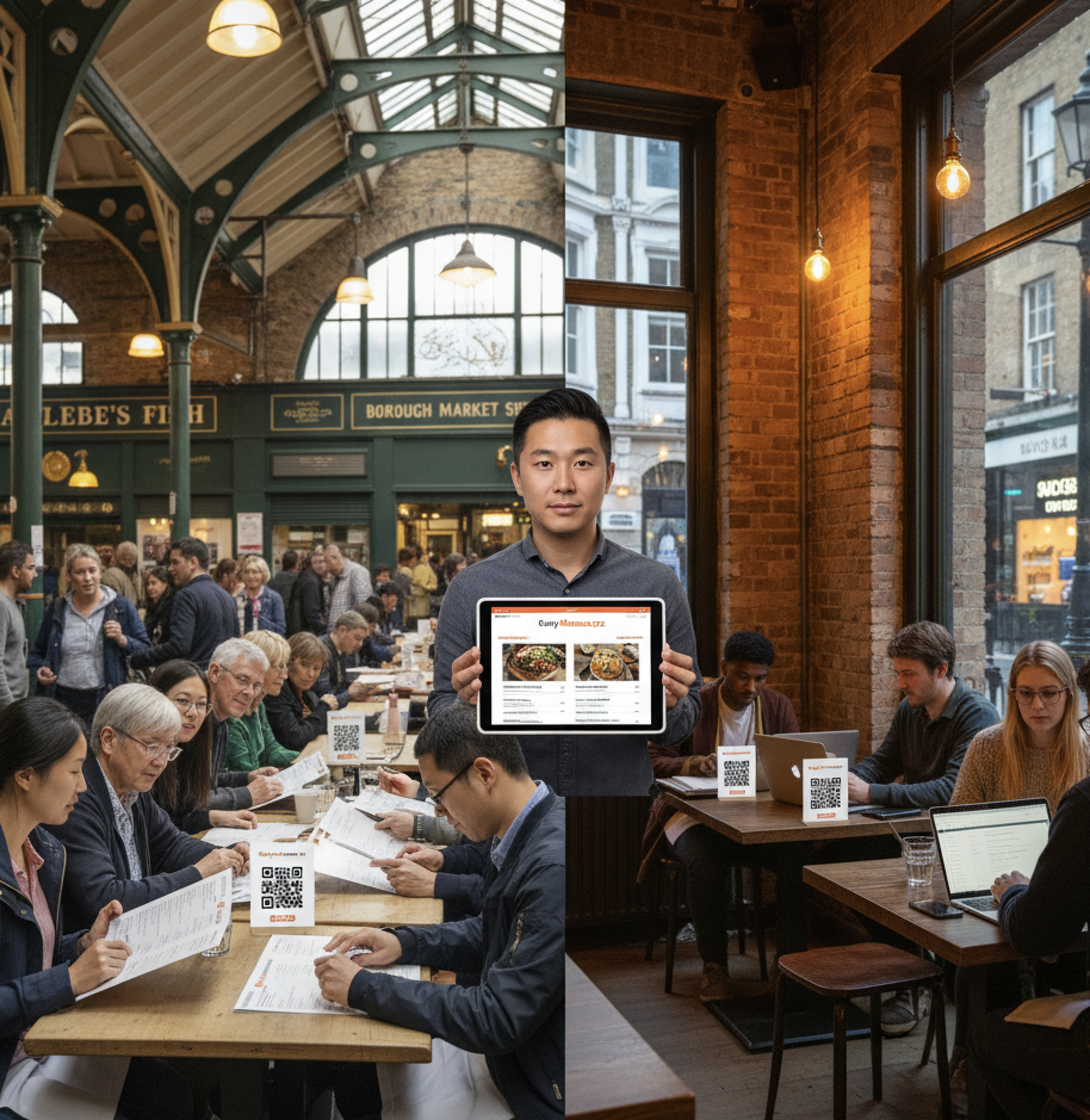 TLDR: Two London Food Scenes, Different Adoption Speeds
Shoreditch restaurants adopt digital menus 30-50% faster than Borough Market establishments. Not because of budget differences. Because of customer expectations.
Shoreditch: 76-82% of customers aged 20-39. Work at Google, Facebook, Amazon. Expect QR codes. Trial restaurants showed 80% adoption without staff prompting. Borough Market: 20-25 million annual tourists. Need multilingual menus. Heritage culture values "authentic" printed menus. Adoption is thoughtful, not automatic. Both save £2,000-£7,000 annually eliminating printing costs (£4,800/year), staff explanation time (£1,800/year), and multilingual coordination. Digital menus: £150/year. Your next menu reprint: £45-£200. Setup: 3 minutes. [Start 14-day trial - multilingual support included]##
It's Half Eleven on Thursday Night
You're finally sitting down with a pint after brutal service, scrolling through emails. There it is: your produce supplier. Those heritage tomatoes everyone orders? Season's over. The new variety costs £18 more per case.
You need new menus printed. Again.
Add it up. Every time your fishmonger texts about the day's catch. Every time that natural wine you just added sells out after two days. Every seasonal menu change. That sourdough supplier who just raised prices.
It's probably £1,200 yearly. Maybe £1,500. Possibly £2,000+ if you're running a Borough Market establishment with daily specials boards.Here's what we found researching London's independent restaurant scene: Shoreditch restaurants adopt digital solutions at rates 30-50% higher than Borough Market establishments.
Not because Borough operators don't understand technology. Not because Shoreditch chefs have bigger budgets.
Because Silicon Roundabout's tech culture creates fundamentally different customer expectations.
Two Food Scenes, Different Digital Realities### Borough Market: Heritage Meets 20 Million Tourists
Walk through Borough Market on Saturday afternoon. Count the accents. Japanese. Italian. French. American. Spanish.
Every third table is asking questions your printed menu can't answer:
- "What's a scotch egg?"- "Is this gluten-free?"- "Do you have the menu in German?"- "What exactly is Lincolnshire sausage?"
Your staff explain the same heritage food stories fifty times a shift. The printed menu lists dishes. It doesn't tell the 1,000-year market history. It doesn't translate "bangers and mash" for tourists from Seoul.
Borough Market profile:- 20-25 million annual visitors to the market- Southwark borough: 307,600 residents, median age 33- Heritage provenance culture dominates- Tourism focus: Extreme international demographic- Key areas: Borough Market, Bermondsey, London Bridge, Bankside### Shoreditch: When Your Customers Work At Google
Now walk down Old Street on Tuesday lunch. Google employees. Facebook staff. Startup founders. Tech workers who expect their entire life to be digital.
They're booking tables on apps. Paying with Apple Pay. Checking TripAdvisor reviews while standing at your door.
They scan your QR code without thinking. Because of course there's a QR code. They work at companies that invented QR payments.
And when you don't have one? They're confused. "Do I need to... ask for a menu?"
Shoreditch/Hoxton profile:- 76-82% aged 20-39 (versus 33% London average)- 69% degree-educated in core postcodes- 7,000+ startups (world's third-largest cluster)- Google, Facebook, Amazon, Intel, Microsoft offices- Key areas: Shoreditch High Street, Old Street, Hoxton Square, Brick Lane border## The Printing Cost Reality (That Adds Up Faster Than You Think)
Let's talk actual money. Not "industry estimates." Real costs from real London restaurants.
Borough Market Restaurant Monthly Reality
Typical independent establishment:- Menu reprints (seasonal): £45 × 8 times/year = £360- Daily specials boards: £25/week × 52 = £1,300- Wine list updates: £35/month × 12 = £420- Allergen information sheets: £15/quarter × 4 = £60- Annual printing total: £2,140### Roast Restaurant's Complexity
Multiple daily menus create multiplicative costs:
- Breakfast menu: £40 × 4 times/year = £160- Lunch menu: £50 × 6 times/year = £300- Dinner menu: £50 × 8 times/year = £400- Sunday roast special: £35 × 6 times/year = £210- Afternoon tea: £30 × 4 times/year = £120- Daily specials coordination: £100/month × 12 = £1,200- Annual printing total: £2,390### Arabica Bar & Kitchen (2 Locations)
Multi-location coordination multiplies costs:
- Extensive meze with daily specials: £400/location = £800- Wine list updates: £300/location = £600- Specials boards: £50/month × 12 = £600- Multi-location coordination delays: 3-5 days per update- Annual printing total: £2,000+
That's £2,000-£2,400 you're spending to tell customers information that could update instantly on their phone. In their language. With photos showing exactly what "scotch egg" looks like.
And every time you reprint? That's 5-7 days waiting for the print shop. Five days of "sorry, we're actually out of that" conversations with tourists holding menus that say it's available.
Why Shoreditch Adopts Faster: The Customer Expectation Gap
The Clove Club on Old Street? Two Michelin stars. Tasting menus that change constantly. You know who eats there?
Tech executives. Startup founders. People who expect everything to be digital.
They don't carry cash. They book everything on apps. They photograph every course. They work at Google and Facebook where QR code payments and digital experiences are their literal job.
When Shoreditch restaurants trialed digital menus, 80% of customers scanned QR codes automatically without staff prompting. Not 80% eventually adopted. 80% scanned immediately. First time. No explanation needed.
Shoreditch Examples
Brat (Michelin-starred): Whole turbot for two. Ember-grilled everything. Menu changes based on what's available. Crowd: food media, creative agencies, Instagram-documenting everything. They want dish photos before ordering. Bistro Freddie: French bistro classics. Natural wine list that shifts weekly. Tech workers at lunch checking their phones between bites. Why would they wait for printed menus when they could scan instantly? Manteca: Fresh pasta. Italian sharing plates. Daily changing menu. Young chef-operators with startup-adjacent mindsets viewing technology adoption as natural business evolution.The adoption pace is faster in Shoreditch because customer expectations and competitive pressure align.
Borough Market's Different Equation: Heritage Tourism Complexity
Borough Market's strength—heritage tourism and culinary storytelling—creates different adoption dynamics.
Take Padella on Southwark Street. Fresh pasta. Daily changing menu. Queues around the block. They're using QR codes for virtual queue management—not menus yet.
Why? Because the queue system solved an immediate crisis (90-minute physical queues blocking Southwark Street). Menu updates? That's just printing costs. Annoying, but manageable.
The Tourist Translation Problem
Your Japanese tourists don't know what "bangers and mash" means. Your German visitors need "scotch egg" explained. Your Spanish customers are confused by "Lincolnshire sausage."
Right now, your staff explain this fifty times a shift. During peak service. When they're trying to turn tables.
What digital menus solve:Roast Restaurant serves traditional British cuisine to international tourists. "Sunday roast" requires explanation for 60% of their customers. Digital menus provide:
- Auto-translation into customer's phone language- Photos showing what dishes look like- Detailed descriptions with ingredient origins- Allergen information in multiple languages- Heritage storytelling space that printed menus can't provide
Applebee's Fish (family-run 25 years) has supplier stories, sustainability credentials, preparation traditions that deserve detailed explanation. Printed menus don't have space. Digital menus do.
The Heritage Storytelling Advantage (That Nobody Expected)
Here's what surprised us researching Borough Market: digital menus actually enhance heritage storytelling.
Elliot's on Stoney Street sources everything from the market. Daily changing menu. Small plates format requiring detailed descriptions.
Before digital menus, their printed menu listed: "Heritage tomatoes, stracciatella, basil - £9"
Now their digital menu shows:
- Photo of the actual dish- "Heritage tomatoes from Turnips, sourced this morning from Borough Market's oldest greengrocer (family-run since 1948)"- Origin story of stracciatella from Puglia- Basil variety information (Genovese vs. Thai)- Allergen details- Wine pairing suggestion- Available in English, French, German, Spanish, Italian, Japanese
Borough Market's heritage culture initially resisted digital as "inauthentic." Now restaurants discover it tells better heritage stories than printed menus ever could.
The Multi-Location Coordination Problem
Arabica Bar & Kitchen operates two locations: Borough Market and Shoreditch. Same ownership, same menu concept, different execution.
Before digital menus, coordinating meant:
- Update menu design (both locations)- Approve proofs (coordinate with two managers)- Print twice (different delivery times)- Coordinate physical delivery to each location- Staff manually replace menus at every table- Hope both locations implement simultaneously
Now: Update once. Publishes instantly to both locations. Zero coordination lag. Cost: £0.
This isn't hypothetical. Arabica switched six months ago. They've saved £3,200 in printing costs and eliminated approximately 30 hours of coordination time.
What Borough Market Restaurants Are Learning
Mallow (plant-based) discovered their sustainability narrative works better digitally. Detailed producer information, carbon footprint data, seasonal sourcing transparency—printed menus couldn't accommodate it all.
Wright Brothers Oyster & Porter House tells stories about their own oyster farm in Cornwall. Digital menus let them show farm photos, explain cultivation methods, display daily harvests. Heritage storytelling enhanced, not diminished.
Boro Bistro's daily French bistro specials needed explaining to tourists unfamiliar with "pot-au-feu" or "blanquette de veau." Digital menus provide detailed French-to-English translations with preparation method explanations.
The pattern: Borough Market restaurants adopting digital menus for operational efficiency (cost savings, multilingual support) discover enhanced storytelling capacity they didn't expect.
The Honest Cost Comparison### Shoreditch Independent Restaurant- Current printing: £3,000/year (frequent menu changes, natural wine lists, daily specials)- Staff explanation time saved: £1,440/year (estimated 3 hours weekly at £30/hour including payroll)- Total annual benefit: £4,440- Digital menu cost: £150/year- Net savings: £4,290 annually### Borough Market Tourist-Heavy Venue- Current printing: £4,800/year (multilingual versions, high update frequency, tourist-driven changes)- Staff explanation time saved: £1,800/year (significant multilingual assistance reduction)- Multilingual coordination: £600/year (elimination of multi-version print management)- Total annual benefit: £7,200- Digital menu cost: £150/year- Net savings: £7,050 annually### Roast Restaurant (Multiple Daily Menus)- Current printing: £2,390/year (breakfast, lunch, dinner, afternoon tea, Sunday roast)- Staff efficiency: £2,160/year (reduced explanation time across multiple services)- Menu version coordination: £900/year (elimination of multi-version management complexity)- Total annual benefit: £5,450- Digital menu cost: £150/year- Net savings: £5,300 annually
Most restaurants save the annual subscription cost in their first menu update alone.
What This Doesn't Fix
Digital menus don't eliminate the need for good menu design. Poorly designed digital menus are just as bad as poorly designed printed ones.
They don't change customer preferences. Some Borough Market tourists prefer physical menus. Some older visitors find QR codes confusing. Keep 2-3 printed reference menus for customers who request them.
They don't automatically improve food descriptions. You still need clear, appetizing copy. Digital just makes updating and translating that copy faster and cheaper.
What digital menus fix: the cost, coordination, and currency problems of printed menus. The ability to tell better stories. The capacity to serve international customers in their native language.
How This Actually Works (When You're Ready)### Week 1: Setup (3 Minutes)- Upload current menu photos or PDF- System extracts dishes automatically- Review and adjust- Generate QR code- Print QR code table tents (one-time: £150-£200 for professional displays)### Week 2-4: Transition- Place QR codes on tables- Keep printed menus available initially- Observe customer behavior (most scan automatically in Shoreditch, many do in Borough Market)- Staff mention option to customers who look confused### Month 2+: Full Operation- Most customers automatically scan QR codes- You update menu whenever needed (instantly, from your phone)- Printing costs drop to near-zero- Staff efficiency improves (less time explaining, more time serving)- Customer questions decrease (information is clearer)
The honest reality: First week feels weird. Second week feels normal. Third week you're updating prices from your phone while drinking your after-service pint, and it feels like magic compared to calling the print shop.
The Cultural Truth
Shoreditch's tech culture creates faster adoption:
- 76-82% customers aged 20-39 (digital natives)- 80% QR code adoption without prompting- Tech industry workers expecting digital-first everything- Competitive pressure to stay current- Young chef-operators with startup mindsets
Borough Market's heritage tourism creates thoughtful adoption:
- 20-25 million annual tourists needing multilingual support- Heritage preservation values creating initial caution- Operational pain points (queue management, space constraints, tourist questions)- Storytelling needs exceeding printed menu capacity- "Digital-first borough" infrastructure supporting adoption
Neither approach is wrong. Customer culture just changes the urgency.
Try It Before Your Next Reprint
Cost: £12.50/month (£150 yearly)Setup time: 3 minutes
Savings: £2,000-£7,000+/year depending on menu change frequency
Payback period: Less than one month
Risk: £12.50 to try it. If you hate it, back to the print shop.
Most Shoreditch restaurants making the switch wish they'd done it sooner because their customers expected it.
Most Borough Market restaurants adopting find the storytelling enhancement exceeds expectations.
Your next menu reprint costs more than a month's subscription. Try digital first.
[Start your 14-day trial - unlimited updates, multilingual support included]Related High-Volume Operations:
- Queue Management Lessons from Padella and The Clove Club's Digital Systems Padella proved Borough Market customers use QR codes when benefits are obvious—90-minute queues recovered £105,950 annually through digital flow optimization- Vancouver's Gastown Asian QR Expectations: When 43% of Customers Already Expect Digital Vancouver's tech culture and Asian QR familiarity drives 30% faster digital menu adoption than Toronto—similar to Shoreditch's Silicon Roundabout advantage
- How Borough Market Restaurants Serve 20M Tourists Without £8K Translation Costs Serving 20-25 million international visitors requires instant translation—staff time savings of £13,440 annually through automated multilingual menus
- Natural Wine List Management: Real-Time Updates for Small-Producer Bottles Wine lists changing constantly require digital solutions—P Franco's 37 list changes yearly cost £1,295 in printing plus £46,800 in lost revenue from availability complaints
Common Questions#### Why do Shoreditch restaurants adopt digital menus 40% faster than Borough Market?
Tech industry culture creates different customer expectations. Shoreditch demographics skew 76-82% aged 20-39 (digital natives), plus Google, Facebook, Amazon, and 7,000+ startup workers who expect digital-first everything. Trial restaurants showed 80% QR code adoption without staff prompting—customers scanned automatically because that's how they interact with everything. Borough Market's 20-25 million annual tourists include older demographics and international visitors with varying tech comfort. Heritage preservation values (1,000-year market history) create tension between innovation and authenticity. Both areas benefit, but Shoreditch adoption is faster due to customer expectations.
How much do London restaurants actually save switching to digital menus?
Borough Market restaurants save £6,000-£7,000 annually: printing elimination (£4,800/year for multilingual versions), staff efficiency from reduced explanation time (£1,800/year), and multilingual coordination (£600/year). Roast Restaurant with multiple daily menus (breakfast, lunch, dinner, afternoon tea) spends £2,390/year just on printing. Digital menus cost £150/year (£12.50/month), creating net savings of £5,300+. Shoreditch tech-adjacent venues save £4,000-£4,500 annually through reduced printing (£3,000/year for frequent updates) and staff efficiency (£1,440/year). Natural wine list updates alone can cost £35-£50 monthly that digital solutions eliminate instantly.
How do multilingual digital menus help Borough Market serve 20+ million annual tourists?
Borough Market attracts massive international visitor numbers requiring constant translation. Explaining "bangers and mash," "scotch egg," or "Lincolnshire sausage" to Japanese, German, Spanish, French, and Italian tourists consumes significant staff time during peak service (estimated 50+ explanations per shift). Digital menus auto-detect customer phone language and display appropriate translations with photos. Roast Restaurant's heritage British cuisine, Applebee's Fish supplier stories, and Elliot's market-driven small plates all need context that printed menus can't provide. Staff focus shifts from basic translation to hospitality and recommendations, improving service speed while accommodating international visitors naturally.
What heritage storytelling advantages do digital menus offer Borough Market restaurants?
Borough Market's provenance culture requires more space than printed menus allow. Applebee's Fish (family-run 25 years) has supplier stories, sustainability credentials, preparation traditions deserving detailed explanation. Elliot's daily market-sourced menu needs origin information for each ingredient. Digital menus provide unlimited space for producer histories, seasonal British sourcing details, sustainability practices, preparation methods, detailed allergen information, and wine pairing suggestions. Mallow's plant-based sustainability narrative, Wright Brothers' own oyster farm story with photos, and Boro Bistro's French bistro technique explanations all benefit from digital storytelling capacity that printed menus physically cannot support. Heritage enhancement, not replacement.
How does Shoreditch's Silicon Roundabout tech culture affect restaurant adoption rates?
Shoreditch houses 7,000+ startups (world's third-largest cluster after San Francisco and New York), plus major Google, Facebook, Amazon, Intel, and Microsoft offices. Restaurant customers literally build payment technology, booking platforms, and digital experiences professionally—they expect seamless digital integration in all services. Young chef-operators often have tech backgrounds or startup investor backing, viewing technology adoption as natural business evolution. Trial data shows 80% QR code adoption without staff prompting. Competitive pressure among Michelin-starred establishments (The Clove Club, Brat, Lyle's) and buzzy independents (Bistro Freddie, Manteca, Via Emilia) drives rapid innovation. Being "behind" technologically carries reputational risk when serving food media, creative agencies, and tech executives documenting everything on social platforms.
Do older Borough Market tourists actually use QR code menus?
Adoption varies by demographic, but current Borough Market data shows 55-60% of 60+ visitors scan QR codes when presented naturally, another 20-25% scan after brief staff encouragement ("You can scan this QR code to see our menu in [their language]"). Keep 2-3 printed reference menus for the 15-20% who prefer them. Key difference from general UK adoption: Borough Market tourists are often international visitors from countries with higher QR code usage (Japan, France, Germany, Spain) where restaurant QR codes are more common than in UK. Heritage venues report 70-75% total adoption within first two months as customers see others using it naturally.
Keep reading
Free 5-day course: Get Your Restaurant Found on Google
One short email a day for 5 days. No fluff. Actionable steps you can do today.
One-click unsubscribe. No spam. Reply anytime to hello@easymenus.net.
Ready to create your digital menu?
Join thousands of restaurants already using EasyMenus. Free forever — no credit card needed.
Get started free →