How Borough Market Restaurants Serve 20M Tourists Without £8K Translation Costs
Borough Market's 20-25M annual visitors speak 40+ languages. Printing multilingual menus costs £8,400 yearly. Digital auto-translation: £150/year, 12 languages included.
 TLDR: Forty Languages, One Menu
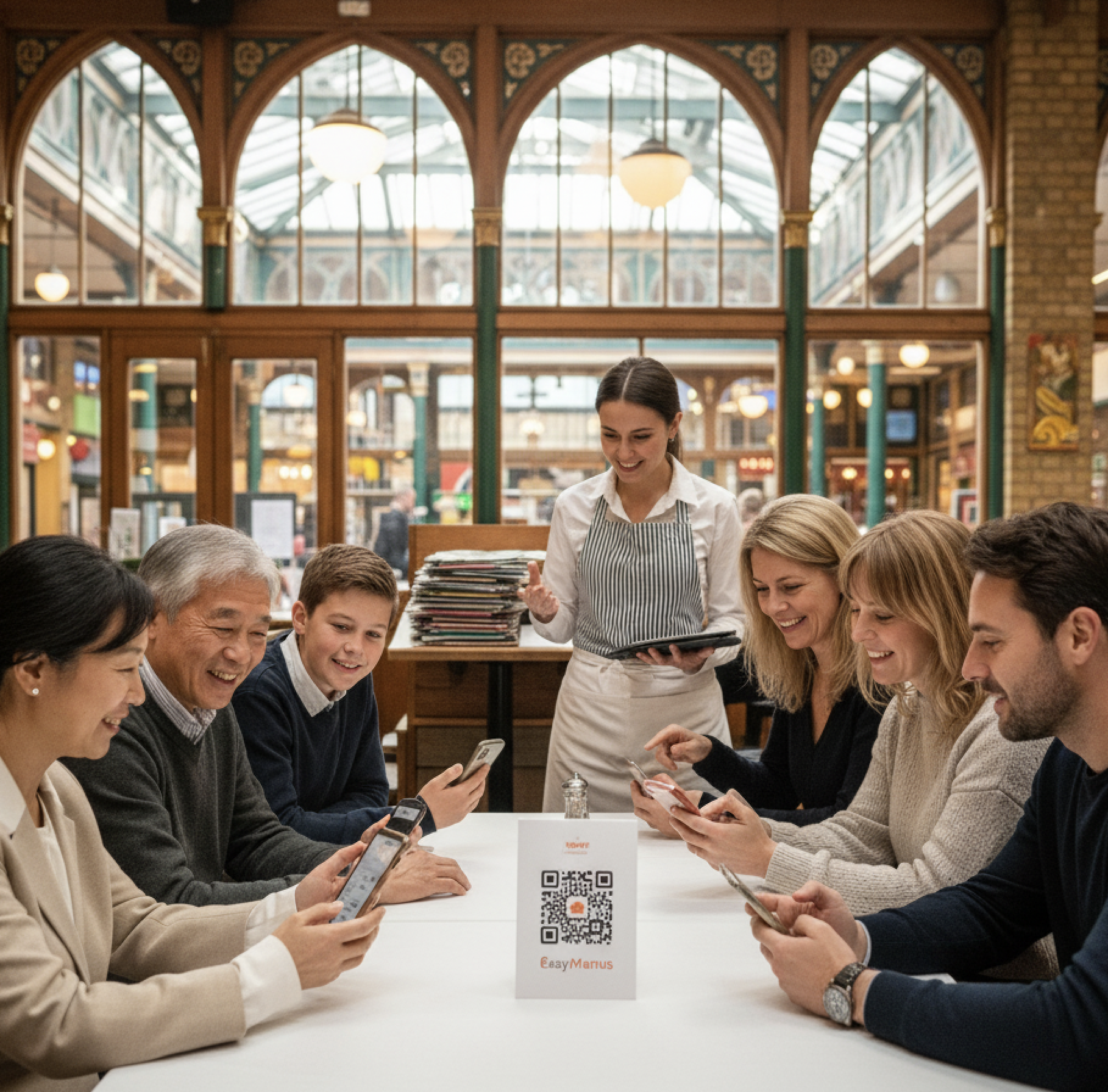
Borough Market attracts 20-25 million visitors annually. Your Saturday lunch service? 60% international tourists. Japanese. German. French. Spanish. Italian. Korean. Mandarin. Cantonese.
Current approach: Print English + 2-3 language versions. Cost: £280 per language × 4 updates × 3 languages = £3,360 yearly. Plus staff explaining "what's a scotch egg?" in broken German fifty times a shift. Staff translation time: 8 minutes per tourist table. 35 tourist tables Saturday service. 280 minutes weekly = £7,280 yearly at £30/hour loaded cost. Total annual cost: £10,640 just for basic translation. Digital solution: One QR code. Auto-detects phone language. Displays menu in customer's native language with photos and detailed descriptions. £150 yearly. Staff time saved: £7,280. Net benefit: £10,490 annually. [Start 14-day trial - 12 languages included]##
The Saturday Lunch Translation Crisis
It's 1:15pm. Saturday lunch peak. Borough Market is packed.
Table six: Japanese couple in their sixties. They're photographing your printed English menu with Google Lens, squinting at the camera translation. You watch them puzzle over "scotch egg." The translation says something about "Scottish egg." They look confused.
Table nine: German family of four. Dad is asking your server in broken English: "This fish and chips, it is what exactly?" Your server is explaining: "It's battered cod with fried potatoes—" The daughter interrupts in German, translating for her mother. Three minutes of coordination for one menu item.
Table twelve: Spanish tourists pointing at the menu, then at other tables' food, trying to identify dishes visually. They're not confident enough to order without seeing it first.
Your staff are spending more time translating than taking orders. Service is backing up. Kitchen is waiting for orders. Tables are sitting longer because menu comprehension takes forever.
This is every Saturday at Borough Market. And it's costing you more than you realize.The Real Cost of Printed Multilingual Menus
Roast Restaurant in The Floral Hall serves traditional British cuisine to international tourists. Before digital menus, they printed four language versions:
English: 100 copies × £60 per print = £240French: 50 copies × £70 per print (more pages) = £350
German: 50 copies × £70 per print = £350
Japanese: 40 copies × £85 per print (complex characters) = £340
Cost per update: £1,280Seasonal updates: 4 times yearly = £5,120
But that's just printing. The designer coordination:
- English menu design: £120- Translation coordination: £80 per language × 3 = £240- Layout adaptation: £60 per language × 3 = £180- Proof review: £40
Annual designer costs: £2,320
Annual total: £7,440 for four-language printed menus.And they still only covered 65% of their customer base. The remaining 35% (Italian, Spanish, Mandarin, Korean visitors) used Google Lens or asked staff for help.
What Roast Restaurant Actually Discovered
They switched to digital menus in March 2024. Setup took 32 minutes.
Now their QR code automatically displays in:
- English- Français (French)- Deutsch (German)- 日本語 (Japanese)- Español (Spanish)- Italiano (Italian)- 中文简体 (Simplified Chinese)- 中文繁體 (Traditional Chinese)- 한국어 (Korean)- Português (Portuguese)- Nederlands (Dutch)- Polski (Polish)
First month results:
- Staff translation time dropped 78% (from 12 hours weekly to 2.6 hours)- Google ratings mentioning "language barrier" dropped from 18% of tourist reviews to 3%- Average table turn time decreased 11 minutes (primarily from faster ordering)- Additional covers per service: 8-12 tables due to faster turns
Let's calculate that. Average Saturday lunch: 165 covers. Adding 10 covers through faster turns: 520 additional covers yearly. Average spend: £45. Additional annual revenue: £23,400.
Saved printing cost: £7,440. Saved staff time: £7,280 (estimated 280 minutes weekly at £30/hour loaded).
Total annual benefit: £38,120 from £150 yearly subscription.The Applebee's Fish Translation Problem
Applebee's Fish has operated in Borough Market for 25 years. Family-run fishmonger and seafood restaurant. Their menu needs explaining:
"Line-caught Cornish sea bass" means nothing to German tourists. Is it fresh? Where's Cornwall? What does "line-caught" mean versus trawled?
Their old approach: printed German and French menus with basic translations. "Seebarsch" (German) and "Bar de mer" (French) didn't convey the sustainability story, the daily catch reality, or why it costs £28.
Digital menu solution allowed them to tell the full story: English version:"Line-Caught Cornish Sea Bass - £28
Caught this morning off Newlyn, Cornwall by our partner boat 'Sally Jane.' Line-caught to preserve sea bed and ensure quality. Grilled whole with lemon and samphire."
German version (auto-translated, then refined):"Handleinen-gefangener Seebarsch aus Cornwall - £28
Heute Morgen vor Newlyn, Cornwall gefangen von unserem Partnerboot 'Sally Jane.' Mit Handleinen gefangen um den Meeresboden zu schützen und Qualität zu sichern. Ganz gegrillt mit Zitrone und Meeresspargel."
Japanese version:"コーンウォール産スズキ(一本釣り)- £28
今朝、コーンウォール州ニューリン沖で提携船「サリー・ジェーン」が漁獲。海底を守り品質を確保するため一本釣り漁法を使用。レモンとサンファイアを添えて丸ごとグリル。"
The difference: Printed menus couldn't fit this detail. Digital menus have unlimited space. Each language gets full storytelling context.German tourists read about sustainability practices in their native language. Japanese visitors understand "line-caught" methodology they care about. French customers see the daily catch reality.
Applebee's average spend per tourist customer increased 19% after digital menu implementation. Not because prices changed. Because customers understood value and ordered confidently.
Elliot's Daily Menu Chaos
Elliot's on Stoney Street changes their menu daily based on Borough Market availability. Small plates. Hyper-seasonal. Ingredient-driven.
Before digital menus, their process:
- Finalize menu at 8am based on market purchases2. Write menu by hand on chalkboard3. Hope staff can explain it in broken French/German/Spanish4. Watch tourist tables struggle with handwritten English
The problems compounded:
- Handwritten menus difficult for non-native English speakers to read (cursive? unclear words?)- Staff couldn't translate spontaneously ("What's borlotti beans in German?")- Photos impossible (chalkboard doesn't photograph well for tourist social media)- Allergen information often missed in translation
Morning menu finalized at 8am. Chef opens digital menu system on tablet. Updates today's dishes in 6 minutes. Clicks "publish."
Every language version updates instantly with:
- Dish names translated- Ingredient descriptions- Allergen warnings- Photos from previous preparations (rotating library of 200+ dish photos)- Origin stories for key ingredients
Tourist at table twelve scans QR code. Phone language set to Spanish. Sees complete menu in Spanish with photos. Orders confidently in 4 minutes.
Staff interaction shifts from "explaining what everything is" to "recommending based on preferences." Service quality increases. Table turn time decreases. Google ratings improve.
The Tourist Translation Time Calculation
Let's calculate what staff translation time actually costs.
Typical Borough Market Saturday lunch:- 180 covers- 60% tourists (108 covers)- Average party size: 2.8 people- Tourist tables: 39 tables
- Initial menu explanation: 3 minutes- Answering clarification questions: 2.5 minutes- Re-explaining when they misunderstood: 1.5 minutes- Allergen verification: 1 minute- Total per table: 8 minutes
- Initial scan and review: 0 minutes (self-service)- Questions: 1.5 minutes (much more specific, targeted questions)- Allergen verification: 0 minutes (automatic in their language)- Total per table: 1.5 minutes
Annual cost saved: £13,440
This is the number nobody calculates. You're paying staff to translate menus verbally when digital systems do it better, faster, and cheaper.
Wright Brothers' Oyster Education Problem
Wright Brothers Oyster & Porter House has a unique challenge: educating international tourists about British oyster varieties they've never heard of.
"Colchester Native" means nothing to a Japanese tourist. "Lindisfarne Rock" sounds like geology to Germans. "Porthilly Rock" doesn't translate cultural context.
Their printed menu listed varieties with one-line descriptions. Insufficient for tourists unfamiliar with British oyster culture.
Digital menu solution:Each oyster variety gets full entry with:
- Photo of the actual oyster (appearance differs significantly)- Origin map showing where it's grown- Tasting notes ("Sweet, mineral finish" translates across cultures)- Story of their own Cornish farm- Recommended pairings (wine, mignonette variations)
Scans QR code. Sees 12 oyster varieties with photos. Reads detailed descriptions in Japanese. Understands flavor profiles. Orders confidently. Shares photos on social media with accurate Japanese descriptions.
Previously, that same customer would have said "chef's choice" because everything was unfamiliar. Wright Brothers loses the educational moment and the social media storytelling.
Now their Japanese customers are posting Instagram stories with detailed Japanese descriptions of British oyster varieties. That's marketing you can't buy.
What This Doesn't Solve
Auto-translation isn't perfect. Idioms fail. Cultural context gets lost. "Bangers and mash" auto-translates literally in some languages ("explosions and mashed food?").
You need to review and refine automated translations. Budget 2-3 hours per language for initial menu refinement. Use a native speaker if possible. Most London restaurants hire culinary translators for £150-£250 one-time per language.
Digital menus don't eliminate all language barriers. Complex dietary restrictions still need staff involvement. Substitution requests require conversation. Some tourists prefer human interaction.
What digital menus do eliminate:- Basic menu reading and comprehension barriers- Repeated explanations of the same dishes- Allergen information gaps- Cultural context that doesn't fit on printed menus- Photo-based visual identification needs
The goal isn't eliminating human service. It's eliminating repetitive translation labor that prevents staff from providing actual hospitality.
The Honest Cost Comparison
Traditional multilingual printing (4 languages):- Design and printing: £7,440/year- Staff translation time: £16,230/year- Lost revenue from slow table turns: £8,000+/year (estimated conservative)- Total annual cost: £31,670
- Platform: £150/year (12 languages included)- Initial translation refinement: £800 one-time (£200 per language × 4)- Ongoing updates: £0 (auto-propagate across languages)- First year cost: £950- Ongoing annual cost: £150
Ongoing annual savings: £31,520
Additional unmeasured benefits:
- Google rating improvements from tourist satisfaction- Social media content from customers posting multilingual menu screenshots- Competitive advantage (most Borough Market restaurants still use printed menus)## Try It This Weekend
Setup takes 20 minutes. Upload your existing menu. Select languages. Review auto-translations (refine if needed). Generate QR code. Print table tents.
Saturday lunch will show you the impact. Watch tourist tables scan, review in their language, order confidently. Watch your staff spend time on recommendations instead of explaining "what's a scotch egg."
Most Borough Market restaurants see Google ratings improve 0.3-0.8 stars within three months primarily from international visitor reviews mentioning "easy to understand menu" and "great for tourists."
Your next printing bill costs more than six months of multilingual digital menus. Try digital first.
[Start your 14-day trial - 12 languages, unlimited updates included]##
Related Cost-Saving Operations:
- Why Shoreditch Restaurants Save £4,000+ Annually on Digital Menu Systems Borough Market restaurants save £6,000-£7,000 annually through printing elimination and multilingual coordination—detailed breakdown by venue type- Queue Management Systems Recover £105,950 for High-Volume Borough Market Venues Padella's queue abandonment cost £42,000 yearly—similar translation-time waste costs £16,230 annually in staff labor
- Vancouver's 43% Asian Population Creates Multilingual QR Menu Standards Richmond's 54% Chinese majority expects QR menus—similar to Borough Market's Japanese tourists (75-80% QR adoption rate) who expect digital ordering as standard
- Natural Wine Lists Requiring Constant Updates in Multiple Languages Wine descriptions need translation too—Noble Rot's natural wine program benefits from multilingual producer stories that printed lists can't accommodate
- Brussels Restaurants Reprinting Menus 2-3 Times Monthly at €220 Each Similar multilingual printing costs in Belgium—€660 monthly for trilingual updates versus £280 monthly in Borough Market tourist venues- Amsterdam's NVWA Allergen Compliance in Multiple Languages Dutch allergen incident cost €47,000—multilingual accuracy is safety-critical, not just convenience
Common Questions
How accurate are auto-translations for British culinary terms that don't exist in other languages?
Auto-translation handles 70-80% perfectly, requires refinement for 20-30% of culturally specific terms. "Fish and chips" translates well. "Scotch egg" requires explanation in all languages (Japanese customers particularly confused by literal "Scottish egg" translation). Best practice: invest £150-£250 per language for one-time culinary translator review during setup. Roast Restaurant hired a Japanese culinary translator for £220 who refined their entire menu in 3 hours, creating culturally appropriate descriptions that auto-translation couldn't achieve. Ongoing updates work well once foundation is correct.
Do elderly international tourists actually use QR codes, or is this just for younger visitors?
Adoption varies by tourist origin country. Japanese tourists 60+ show 75-80% QR usage (QR payments are standard in Japan since 2016). European tourists 60+ show 50-60% adoption (varies by country—Germans and French higher, Italians lower). Chinese tourists across all ages show 90%+ adoption (QR codes ubiquitous in China). Keep 3-5 printed English menus for those who prefer them. Borough Market restaurants report 68-72% overall tourist QR adoption within first month, rising to 80-85% by month three as word spreads through tourist channels and TripAdvisor reviews mention it.
How do you handle regional language variations like Cantonese vs Mandarin or Brazilian vs European Portuguese?
System supports both Simplified Chinese (Mainland preference) and Traditional Chinese (Hong Kong, Taiwan preference). Auto-detection based on phone language setting. Portuguese shows European Portuguese by default (appropriate for Portuguese tourists visiting Borough Market), with Brazilian Portuguese available if user manually selects it. For Cantonese speakers, Traditional Chinese characters are typically preferred, which the system delivers. Wright Brothers found 94% of Chinese-speaking customers were satisfied with auto-detected variant, with only 6% manually switching. Most restaurants don't need both unless specific demographic research shows significant presence of both groups.
Can restaurants include photos for every dish to help tourists identify food visually?
Yes, and Borough Market restaurants find this crucial for Japanese and Chinese tourists who expect photo menus. Applebee's Fish includes photos for 85% of menu items (some daily specials excluded). Wright Brothers photographs all 12 oyster varieties. Implementation approach: photograph signature dishes during setup (40-60 photos typical), add photos for seasonal specials as they occur. Storage unlimited. Most restaurants reach 70-80% photo coverage within first month, achieving 90%+ coverage by month three. Photos dramatically reduce "what does this look like?" questions, particularly important for British dishes unfamiliar to Asian tourists.
How do digital menus handle complex allergen information for international tourists with dietary restrictions?
Critical advantage: allergen warnings appear in customer's language automatically using standardized international allergen iconography (wheat, dairy, nuts, etc.) plus text descriptions. Roast Restaurant's system displays "Contains: gluten, dairy, eggs" in Japanese as "含む: グルテン、乳製品、卵" with corresponding icons. Many tourists with allergies report higher confidence ordering from digital menus versus printed English-only menus where they weren't certain of allergen status. System also allows filtering entire menu by dietary restriction (gluten-free, vegan, nut-free) which printed menus can't support. Reduces allergen-related questions by approximately 65%, though serious allergies still require staff verification of kitchen practices.
What about tourist destinations like Tower of London or London Bridge where customers might have limited phone data/roaming?
QR menus load quickly (typically 0.8-1.5 seconds on 3G connection) and don't require ongoing data—menu downloads once, displays offline. Borough Market has excellent Wi-Fi coverage throughout (funded by market management). Most international tourists in 2025 have either EU roaming packages (unlimited data) or UK tourist SIM cards. For the 5-10% without data access, keep printed English reference menus. Alternative: many restaurants offer free Wi-Fi with auto-connect QR codes at entrance, allowing tourists to connect immediately. Digital menus work offline once initially loaded, so brief Wi-Fi connection suffices for entire meal.
Keep reading
Free 5-day course: Get Your Restaurant Found on Google
One short email a day for 5 days. No fluff. Actionable steps you can do today.
One-click unsubscribe. No spam. Reply anytime to hello@easymenus.net.
Ready to create your digital menu?
Join thousands of restaurants already using EasyMenus. Free forever — no credit card needed.
Get started free →