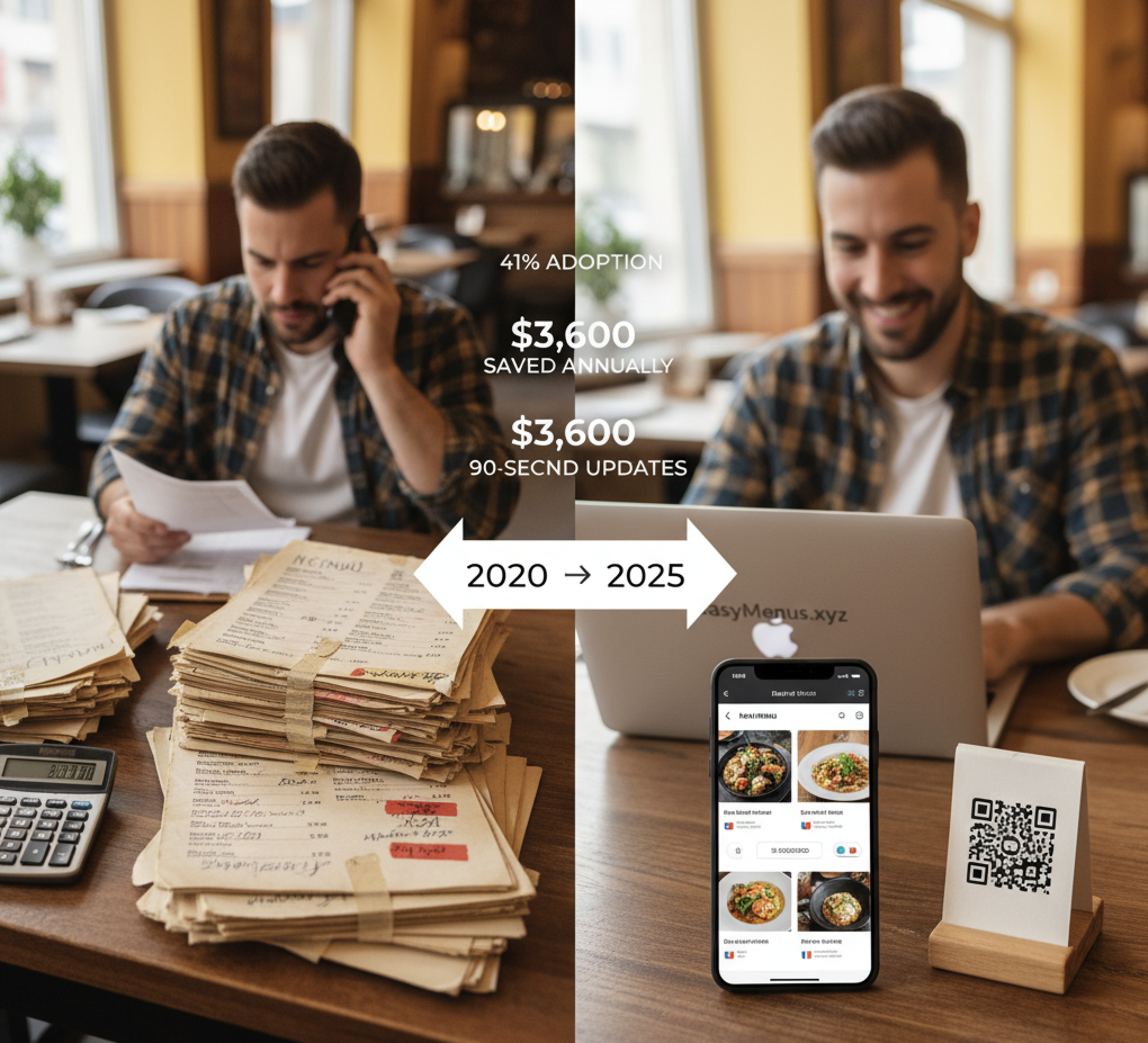
Restaurant menu technology in 2025: QR codes hit 67% adoption, AI personalization emerges, but printed menus aren't dead. Real data on what's working.
This scenario plays out 2,800 times daily across US restaurants. The gap between ingredient reality and printed menu creates liability, wastes money, and stresses owners.
Three technologies are changing this: instant menu updates (67% adoption), dynamic pricing (emerging), and AI personalization (2-3 years out). Here's what's real and what's still theoretical.
March 2025 data from National Restaurant Association: 67% of independent restaurants now use QR codes. That's up from 12% in 2020.
Why the shift? Not COVID. Cost.
Jake runs three pizza places in Portland. Printed menus cost him $840 monthly (3 locations × $280 printing). Ingredient prices changed 4-6 times monthly. Menu was outdated within days.
Digital menus: $37.50 monthly (3 locations × $12.50). Updates take 90 seconds.
Annual savings: $9,630. That's two months of rent on his smallest location.
Who's adopting:Both strategies work. Forcing digital on customers who hate it kills experience. But paying $10,000 annually for printing when your customers prefer digital is equally stupid.
Remember Uber surge pricing backlash? Restaurants learned from that disaster.
Dynamic pricing in 2025 means: off-peak discounts, not peak-time surcharges.
Marcus at The Griffin changed lunch pricing:
Result: 34% increase in 2-4pm covers. Kitchen stays staffed. Food costs amortized across more customers.
Where it works:Simple rule: If dynamic pricing feels like you're taking advantage, you are.
Tech companies promise AI menus that show different items to different customers. Vegan sees plant-based options first. High spender sees premium items.
Reality check: Most restaurants can't even keep their printed menu current. AI personalization requires:
This technology exists. But implementation cost ($15,000-40,000) only makes sense for chains with 20+ locations or venues with $5M+ annual revenue.
For independent restaurants, basic digital menus solve 95% of problems at 2% of the cost.
Don't buy bleeding-edge tech to solve yesterday's problems.
Your food distributor changes ingredient sourcing. Your menu allergen info is now wrong. You find out when a customer has a reaction.
2025 trend: Digital menus connecting directly to supplier databases.
When your distributor switches from butter to margarine in buns, your menu allergen warnings update automatically. No manual checking. No legal liability gap.
Early adopters: Sysco, US Foods piloting this in five markets. Full rollout: 2026-2027.
Cost: Free (bundled with existing contracts). Implementation: 15-minute one-time setup.
This prevents the $47,000 settlement Sarah's Brussels café paid after outdated allergen info caused a reaction.
Instagram generation expects professional food photography. But hiring photographers costs $400-800 per session.
2025 solution: Smartphone + proper lighting + basic editing.
Chen at Dragon Palace takes all menu photos with iPhone 15. Setup:
Results match $600 professional shoots for Instagram/menu purposes. Fine dining still needs pros. Casual dining can DIY.
"Alexa, order my usual from Mario's Pizza."
This technology exists. Adoption? Nearly zero for independent restaurants.
Why? Requires:
File under "cool but irrelevant for 95% of restaurants."
Fine dining customers want physical menus. Traditional venues with older demographics need printed options.
Smart strategy: Digital primary, printed secondary.
Keep 5-10 laminated printed menus for customers who request them. Costs $180 one-time. Satisfies everyone.
James at The Griffin: 73% scan QR codes. 27% request printed. He keeps both. Zero customer complaints.
Remember when everyone thought iPad menus would replace everything?
Problems:
Tablets work in:
For neighborhood restaurants? QR codes work better at 5% of the cost.
Tech companies pitch "blockchain-verified menu authenticity."
This solves a problem that doesn't exist. Nobody questions if your menu is "authentic." They question if the food matches the description.
If a tech solution requires 10 minutes of explanation, restaurants don't need it.
If you're still printing menus 3+ times monthly, switch to digital. Not because it's trendy. Because it saves $3,600-10,000 annually.
Setup: 20 minutes. Monthly cost: $12.50. ROI: Immediate.
When your main distributor offers menu-supplier integration, take it. Free implementation. Eliminates allergen compliance gaps.
This prevents lawsuits, not improves customer experience. Different value, equally important.
Only if:
If you're a single-location restaurant struggling with basic menu updates, AI personalization is
like buying a Ferrari when you need an oil change.
Restaurant technology future isn't flashy. It's:
The future is eliminating friction, not adding features.
Marcus saved $9,630 annually with digital menus. That's not revolutionary technology. That's basic efficiency unlocked.
Most restaurant technology "innovation" is solving problems software companies invented. Real innovation solves problems restaurant owners actually have.
Adoption plateaued at 67% in 2025. That remaining 33% prefers printed - and that's fine. Keep both options. Total printed menu cost drops 90% when you only need 5-10 laminated copies instead of 200 disposable ones.
Not yet. Current AI systems cost $15,000-40,000 implementation plus $300-800 monthly. ROI only makes sense for large chains. Wait until costs drop below $2,000 implementation and prices become month-to-month. Probably 2027-2028.
For independent restaurants? No. Requires expensive POS integration, forces customers to create accounts, and adoption rates hover around 2%. Table ordering (QR code → phone) is simpler and customers already do it voluntarily.
Gimmick. Customers point phone at table, see 3D food models. Implementation costs $8,000-15,000. Customer confusion rate: 60%. Better photos on regular digital menus achieve same goal at zero extra cost.
Ask: "Does this save me time or money, or does it just look cool?" If answer is "looks cool," wait 2 years and see if anyone's still using it. Most restaurant tech hype dies within 18 months.
Technology changes fast. Restaurant fundamentals don't.
Customers want: Good food, fair prices, clear menus, minimal friction.
Technology should remove friction, not add it. If a new menu technology requires staff training, customer education, or 10-minute explanations, it's not ready.
Digital menus (current technology) solve real problems:
That's enough innovation for most restaurants.
The future of restaurant menus isn't about flashy technology. It's about basic digital infrastructure that works reliably and costs less than the status quo.
Jake in Portland doesn't care about AI personalization. He cares about updating prices in 90 seconds when his distributor calls with new costs.
That's the future. And it's already here.
Ready to create your digital menu?
Join thousands of restaurants already using EasyMenus. Free forever — no credit card needed.
Get started free →