Wine List Management for Dutch Restaurants: How Digital Menus Save 30+ Hours Monthly
Dutch restaurants with wine programmes waste 30+ hours monthly managing printed lists. Vintage changes, bottle depletion, pricing updates create operational chaos. Digital: real-time inventory, instan
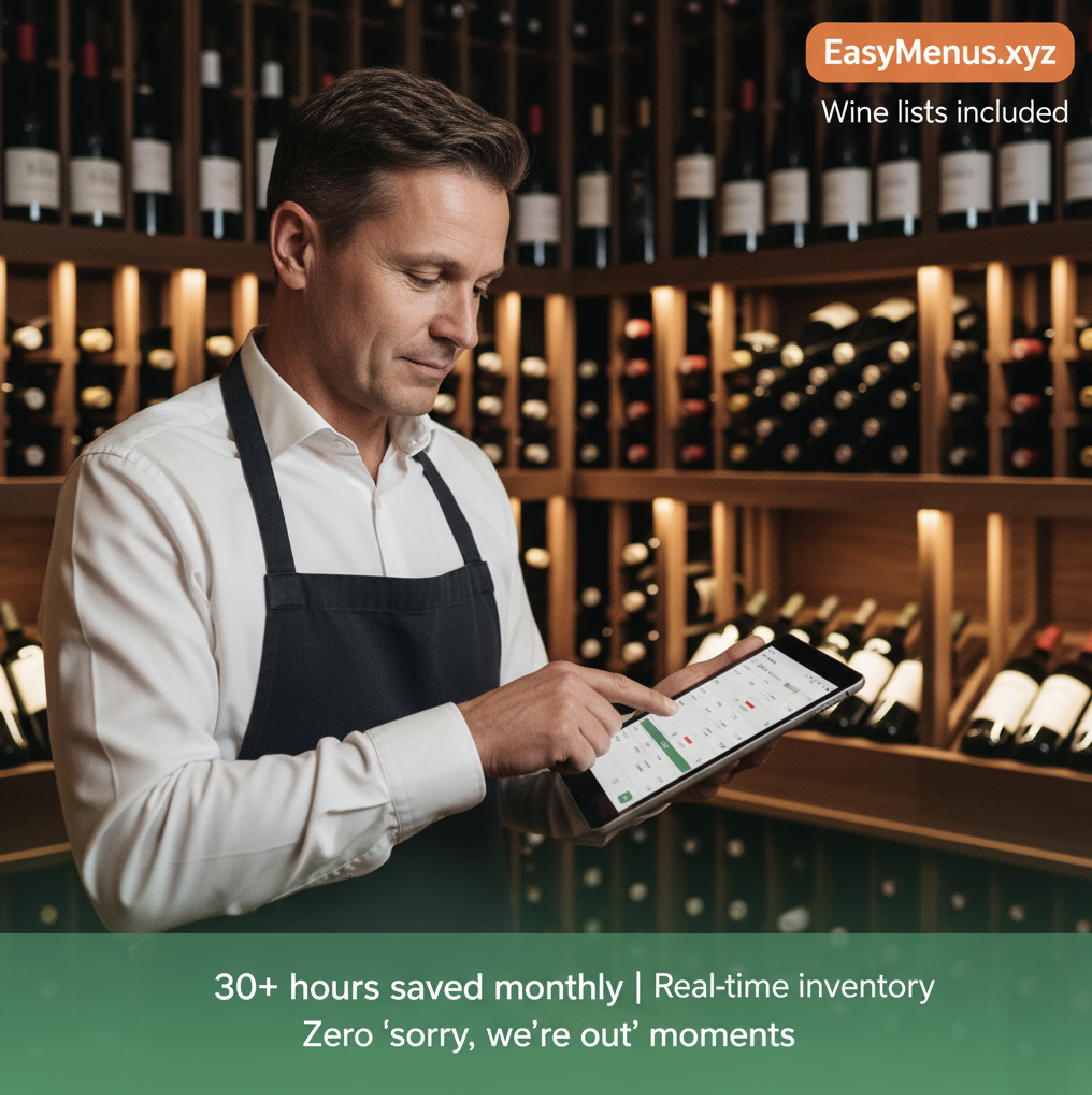
The Wine List Problem You're Not Solving
Your 180-selection wine programme is your competitive advantage. But your printed wine list is sabotaging it.
Tuesday 8:15pm: Customer orders the 2019 Burgundy. Server checks back-of-house. Last bottle sold Saturday. Printed list still shows it available. Customer disappointed, orders cheaper alternative. You've damaged credibility with your most valuable customer segment. This happens 4-8 times nightly in serious Amsterdam wine programmes. Multiply by 25 services monthly = 100-200 disappointed wine customers experiencing "sorry, we're out" conversations that shouldn't happen. The operational burden: 30-35 hours monthly updating printed lists, crossing out sold-out wines in pen, reprinting sections, coordinating with staff, managing vintage transitions, explaining supplier price changes. Digital wine list management: Update inventory in 15 seconds when last bottle sells. Vintage changes in 30 seconds. Pricing adjustments real-time. All languages update simultaneously. Zero "sorry, we're out" surprises. Start 3-minute setup—wine lists includedWhy Wine Lists Are Fundamentally Different From Food Menus### Challenge 1: Bottle Depletion Requires Real-Time Tracking
Food menu items don't disappear item-by-item. You run out of salmon, you 86 it, chef preps more tomorrow. One inventory decision affects one day. Wine bottles deplete individually. That 2020 Barolo? You have 6 bottles. One sells Monday lunch, one Tuesday dinner, one Wednesday, two Friday evening, last bottle Saturday night 9:47pm. Now it's gone permanently—you can't "prep more" next week. Printed list shows wine available Sunday-Wednesday even though last bottle sold Saturday. Every customer who orders it experiences disappointment. Wijnbar Bij Ons (Amsterdam Jordaan, 180+ selections):- Before digital: Averaged 12-15 "sorry, we're out" conversations per week across 6 services- Customer experience: Educated wine enthusiasts notice when lists aren't current. Trip Advisor reviews mentioned "outdated wine list" 8 times in 6 months- Staff frustration: Servers cross out sold bottles in pen on printed lists, creating messy appearance for €18-32/glass wine programme
- Server marks bottle sold in 10 seconds on tablet/phone when opening last bottle- Wine disappears from customer-facing digital menu within 15 seconds- "Sorry, we're out" conversations: Zero (eliminated entirely)- Trip Advisor mentions: "Impressive real-time inventory tracking" (positive instead of negative)### Challenge 2: Vintage Changes Happen Without Warning
What you actually have: Château Margaux 2021 - €155 (new vintage, different price)
Options with printed lists:- Cross out 2020 in pen, write 2021 above it (looks unprofessional for €140 wine)2. Verbally inform every customer "that's actually 2021 now" (confusing, damages trust)3. Rush-print new wine lists (€180-220, 3-day wait)4. Absorb price difference and serve 2021 at 2020 price (lose €15 margin)
- Manages 15-20 vintage transitions monthly across European portfolio- Before digital: Spent €280-340 monthly rush-printing wine list sections for vintage changes- Annual vintage transition printing: €3,360-4,080- Time investment: 8-12 hours monthly coordinating updates
- Vintage arrives Wednesday morning delivery- Manager updates wine list Wednesday 10:30am during morning coffee (2 minutes per wine)- All languages (Dutch/English/French) update simultaneously- Correct vintage + price operational for Wednesday lunch service- Cost: €0 beyond subscription- Time: 30-40 minutes monthly total### Challenge 3: European Supplier Price Volatility Is Extreme for Wine
- January: Base pricing stable- March: Euro/GBP fluctuation +8% price increase- June: 2021 vintage Parker scores published, certain wines +12% overnight- August: Supply constraint (frost damage), remaining bottles +18%- October: New vintage releases, some wines -5%, others +7%
Amsterdam and Rotterdam restaurants spending €960-2,640 annually just on wine list printing
Why wine list printing costs exceed food menu printing per-item: Frequency multiplier: Food menus change 4-6 times/year (seasonally). Wine lists change 12-24 times/year (inventory + vintage + pricing + supplier volatility). Sophistication requirement: Food menu can be simple text. Wine lists need vintage years, regions, tasting notes, ABV, format (bottle/glass), proper accent marks (Château not Chateau), correct spelling (Gewürztraminer not Gewurztraminer). Multilingual complexity: Food translations straightforward. Wine requires cultural context—Dutch "volle smaak" ≠ English "full-bodied" ≠ French "corsé" in nuance. Amsterdam serious wine programme typical costs:- Base printing: €220/version × 12 updates = €2,640- Rush fees (vintage emergencies): €180 × 3 = €540- Multilingual (3 languages): €3,180 × 1.4 = €4,452- Total: €7,632 annually just for wine list maintenance
The Dutch Wine Culture Challenge: Sophisticated Customers Notice Mistakes### Amsterdam Wine Enthusiasts Expect Accuracy
Netherlands ranks #8 globally in wine consumption per capita (32 liters/person annually). Amsterdam specifically has:- 18% of population regularly purchasing €20+ bottles for home consumption- 64% comfortable discussing wine regions, varieties, vintages in restaurant settings- High French and Italian wine literacy (traditional Dutch preference)
- Wrong vintages (2019 listed, 2020 served)- Unavailable selections ("sorry, we're out")- Outdated prices (price on list doesn't match bill)- Incorrect regions (Burgundy wine labeled as Bordeaux)- Missing information (no ABV, no tasting notes, no pairing suggestions)
Rotterdam Neighbourhood Wine Appreciation Growing
Rotterdam wine culture evolving:- Traditional working-class beer preference shifting toward wine appreciation- 12% year-over-year growth in wine sales at Rotterdam neighbourhood restaurants 2020-2024- Younger demographics (28-45) driving demand for quality wine programmes at accessible prices
- Less international travel experience (fewer comparisons to Paris, Rome wine lists)- More price-sensitive (€12-18 glass sweet spot vs Amsterdam €18-28)- Appreciate education and guidance (want descriptions, not assumption of expertise)
- Detailed tasting notes educate customers unfamiliar with varieties- Food pairing suggestions increase confidence to order wine with meals- Lower pricing enabled by elimination of printing waste (pass savings to customers)- Real-time inventory prevents disappointment when trying new wines##
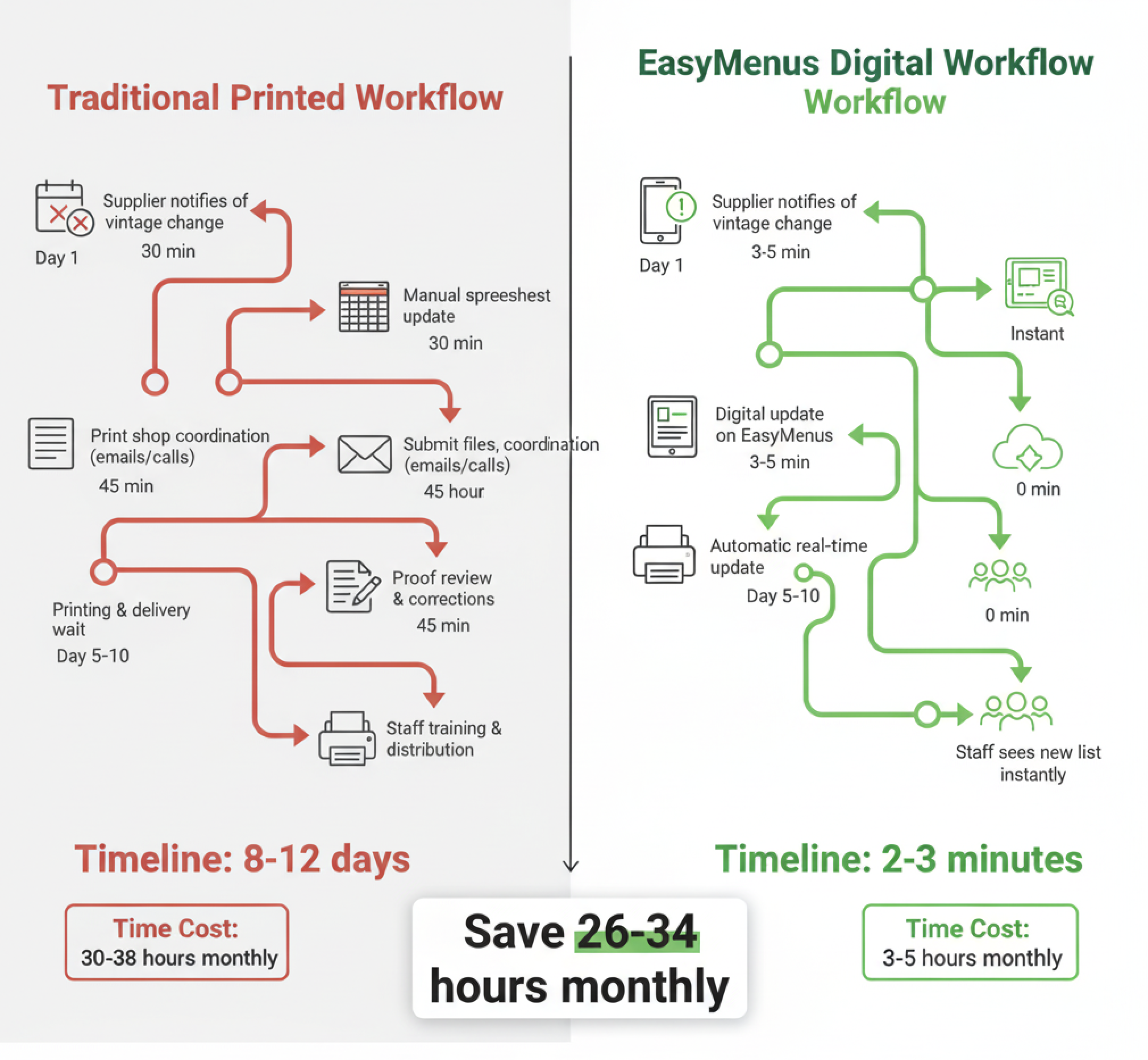
The Operational Workflow: Before vs After Digital### Before Digital: Wine Director's Monthly Time Burden
Week 1 (8-10 hours):- Monday: Review supplier price updates from 4 European sources (2 hours)- Tuesday: Update master wine list spreadsheet with new prices, vintages (3 hours)- Wednesday: Coordinate with print shop on wine list section reprint (1 hour)- Thursday: Review proofs, identify errors, request corrections (2 hours)- Friday: Approve final proof, authorize printing (30 min)
- Monday: Receive printed lists, QA check for errors (1.5 hours)- Tuesday: Train staff on vintage changes, new additions, sold-out removals (2 hours)- Wednesday: Discover 3 wines sold out over weekend not reflected in new printing (30 min frustration)- Thursday: Manually cross out sold wines on all printed lists (45 min)- Friday: Customer complains about outdated list, investigate and apologize (30 min)
- Supplier delivers unexpected vintage changes (2 wines)- Decision: Rush-print update (€180 + 3 days) or manually correct all lists?- Choose manual correction (2 hours staff time)- Field customer questions about handwritten changes (ongoing throughout week)
- Inventory audit before month-end (3 hours)- Identify 8 wines needing removal from printed list (sold out)- Identify 6 vintages that changed without list update (supplier error)- Plan next month's printing cycle- Budget review: €280 spent this month on wine list printing
After Digital: Wine Director's Monthly Time Investment
Week 1 (1.5 hours):- Monday: Review supplier price updates, update digital menu on laptop during morning coffee (45 min)- All prices update across all languages immediately- Staff automatically see changes on customer-facing menus
- Tuesday: Last bottle of Burgundy sells at dinner service- Server marks sold in system (10 seconds)- Wine disappears from menu automatically- Wednesday: New shipment arrives with vintage changes- Update vintages during morning prep (25 min for 4 wines)
- Supplier emergency vintage change- Update during afternoon service gap (5 min)- Operational immediately, no staff coordination needed
- Month-end inventory audit (45 min)- Confirm digital menu accuracy- Identify opportunities for new additions
Case Study: Wijnbar Bij Ons (Amsterdam Jordaan, 180+ Selections)
Profile: Serious wine bar, 180 selections, heavy French and Italian focus, emerging Dutch wine programme, sophisticated Amsterdam clientele, €18-32/glass range. Previous printed wine list approach: Costs:- Base printing: €240 × 18 updates/year = €4,320- Rush printing (vintage emergencies): €220 × 4 = €880- Multilingual (Dutch/English/French): €5,200 × 1.3 = €6,760- Annual total: €11,960
- 15-20 vintage transitions monthly- 25-30 bottle depletions weekly requiring removal- 8-12 supplier price updates monthly- "Sorry, we're out" conversations: 12-15 weekly- Staff frustration crossing out wines, customers noticing messy lists
- Wine director: 32 hours monthly- Staff training on updates: 8 hours monthly- Customer disappointment management: 6 hours monthly- Total: 46 hours monthly
- Photographed existing printed list (15 minutes)- Reviewed digital preview with detailed tasting notes in 3 languages (40 minutes)- Operational Day 3
- Vintage changes: 2-3 minutes per wine- Bottle depletions: 10 seconds per removal- Price updates: 30-45 minutes monthly for all 180 wines- Supplier emergencies: 5 minutes to update- Total time monthly: 4-5 hours
- Annual savings: €11,810 (printing costs)- Time savings: 41 hours monthly = 492 hours annually- "Sorry, we're out" conversations: Eliminated (zero)- Trip Advisor wine mentions: Changed from negative to positive- Average wine sales per table: Increased €12 (customers trust list accuracy, order premium selections)
Dutch Wine Programme Advantages Enabled by Digital### Advantage 1: Emerging Dutch Wine Visibility
Netherlands wine production growing 15-20% annually: Climate change makes traditional beer regions viable for viticulture. Dutch wines emerging from Limburg, Groningen, Zeeland. Challenge: Dutch customers unfamiliar with local wines, need education and confidence-building. Digital solution: Detailed tasting notes in Dutch explaining terroir, highlighting "lokaal product" (local production), comparing to familiar French/Italian styles, suggesting food pairings with Dutch cuisine. Example implementation: Wijnbar Bij Ons added 12 Dutch wines to programme with extensive descriptions. Sales: 18% of wine customers now try Dutch selections (vs 3% when printed list showed minimal information).Advantage 2: Food Pairing Precision
Dutch cuisine + wine pairings require explanation: Stamppot with wine? Bitterballen and Burgundy? Herring and Riesling? Printed lists: Limited space for pairing suggestions (maybe 3-5 words per wine) Digital menus: Full pairing descriptions:- "Pairs beautifully with Dutch herring—Riesling acidity cuts richness, citrus notes complement pickled onions"- "Excellent with stamppot—earthy Pinot Noir complements root vegetables, medium body matches hearty texture"
Advantage 3: Multilingual Wine Education
Amsterdam wine bars serve international tourists + educated locals. Need sophisticated descriptions in multiple languages. Printed challenge: Translating tasting notes accurately is expensive (€40-60/wine across 3 languages) Digital solution: Professional translation one-time, updates automatically, add new languages at zero cost. Example: "Volle smaak, rijp fruit, zachte tannines" (Dutch) → "Full-bodied, ripe fruit, soft tannins" (English) → "Corps plein, fruit mûr, tanins doux" (French). Each translation culturally appropriate, not literal word-for-word.Advantage 4: Vintage Education Reduces Returns
Problem: Customer orders 2020 Bordeaux expecting certain profile. Gets 2021 (different vintage). Disappointed, sometimes returns bottle. Digital solution: When vintage changes, update tasting notes to reflect new vintage characteristics:- "2020: Classic vintage, approachable now, black fruit forward"- "2021: Structured vintage, benefits from decanting, earthy with tobacco notes"
Frequently Asked Questions: Wine-Specific Digital Management### Can I update wine inventory in real-time during service?
Yes. Most restaurants use tablet or phone accessible to service staff. Workflow:- Server opens last bottle of wine2. Opens digital menu manager on tablet (10 seconds)3. Marks wine as sold out (2 taps)4. Wine disappears from customer menus within 15 seconds
What happens when new vintage arrives mid-service?
Realistic timing: New vintages rarely arrive mid-service. They arrive morning delivery. Process:- Morning delivery includes vintage changes- Wine director updates vintages during morning prep (2-3 minutes per wine)- Operational for lunch service
- Update between services or during service gap (2 minutes)- All customer menus update immediately### How do digital tasting notes compare to sommelier recommendations?
Can customers filter wines by region, price, variety digitally?
Yes. Modern digital menus include filtering/search. Customer can filter:- By region: "Show me only French wines"- By price: "€15-25/glass"- By variety: "Pinot Noir"- By characteristics: "Full-bodied reds"- By food pairing: "Pairs with fish"
What about wine lists for customers who prefer printed menus?
Keep 6-8 printed wine lists as backups (refresh quarterly, €140 one-time cost). Reality: 94-97% of Amsterdam/Rotterdam customers prefer digital wine lists because:- More detailed information than printed versions- Filtering/search capabilities- Always current (trust accuracy)- Multilingual without carrying 3 separate printed lists
The Bottom Line: Wine Lists Are Different
Wine lists face challenges food menus don't:
- ✅ Real-time bottle depletion (inventory changes item-by-item)- ✅ Unpredictable vintage transitions (suppliers change without warning)- ✅ Extreme European price volatility (currency, critics, supply constraints)- ✅ Sophisticated customers who notice mistakes (damages credibility)- ✅ Educational requirements (tasting notes, pairings, regions)
Free 5-day course: Get Your Restaurant Found on Google
One short email a day for 5 days. No fluff. Actionable steps you can do today.
One-click unsubscribe. No spam. Reply anytime to hello@easymenus.net.
Ready to create your digital menu?
Join thousands of restaurants already using EasyMenus. Free forever — no credit card needed.
Get started free →