Supplier changed ingredients. Printed menu couldn't update for 3 weeks. One allergic reaction cost €47,000 in fines, settlements, and insurance increases.
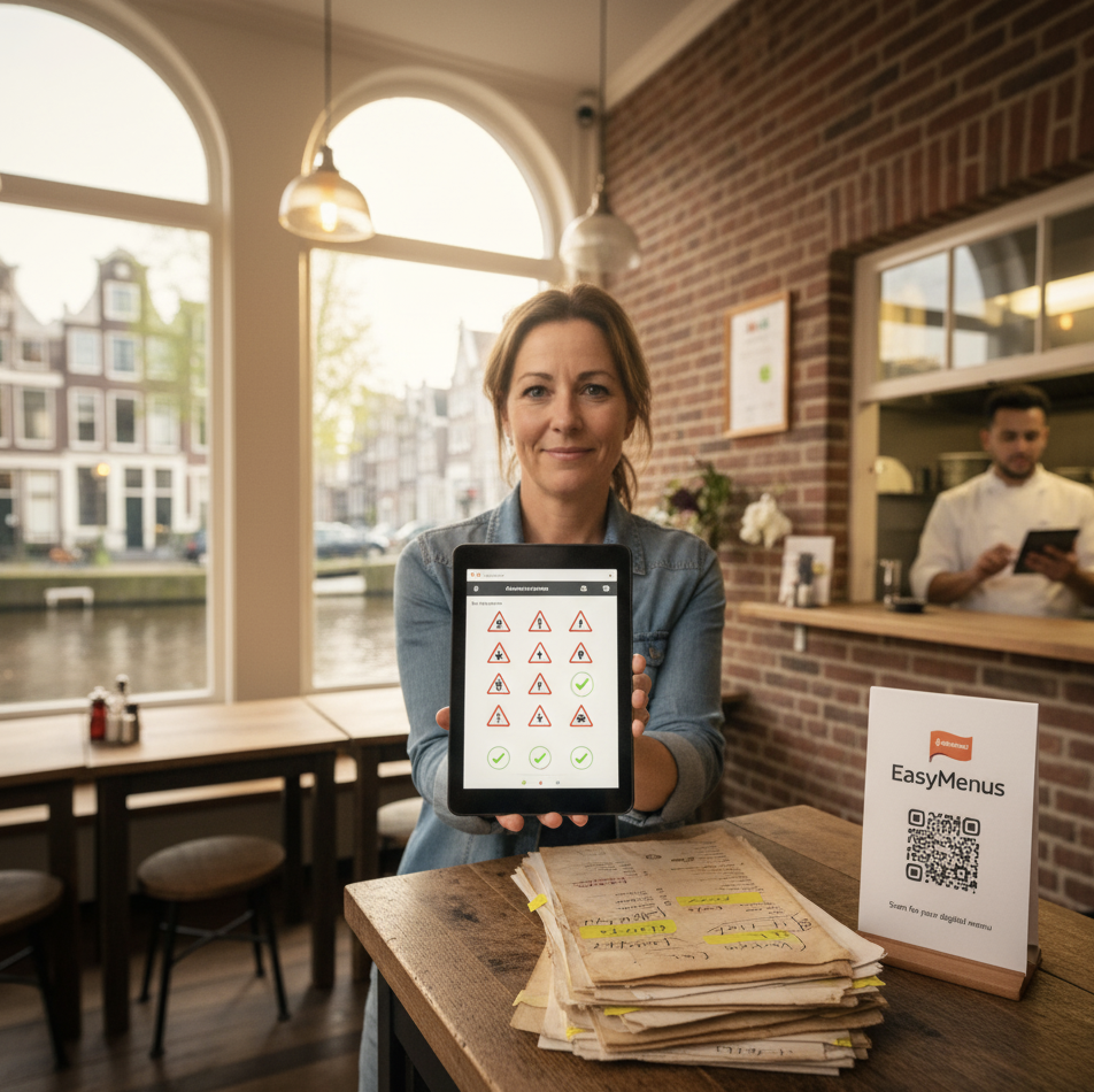
Wednesday morning, 10:35am. Regular customer. Almond croissant. Same order she's made twice a week for eight months.
She took three bites. Then she couldn't breathe.
Her EpiPen was in her bag. Ambulance arrived in eleven minutes. She recovered fully within hours at hospital.
But Saskia's café would never be the same.
What Actually Happened
Three weeks earlier, Saskia's almond supplier sent an email. Subject: "Processing Facility Update"
They were moving to a new facility. The new one also processed peanuts. Under Dutch food safety rules, that meant every product made there now carried a peanut allergen warning. Even if actual peanut contamination risk was minimal.
Twelve items on Saskia's menu used almond flour, almond paste, or sliced almonds. All twelve now needed peanut warnings.
Saskia had three options:
- Reprint immediately (€650 plus €400 rush fees = €1,050)2. Add printed inserts noting the change (looks cheap, customers often remove them)3. Update internal documentation and train staff to verbally warn customers
She chose option three. Cheapest immediate solution. Planned to reprint at next scheduled update in three weeks.
Her newest staff member started two weeks before the supplier email. Young, eager, learning fast. But three weeks into a new job with dozens of dishes to learn.
The regular customer ordered her usual almond croissant. The new staff member checked the printed menu. It showed: "Contains: wheat, dairy, eggs, almonds." No peanut warning. Because the menu was printed before the supplier change.
The staff member didn't know about the verbal warning protocol. Even if she had, remembering to mention peanut warnings for twelve specific items during a busy breakfast rush is exactly the kind of manual process that inevitably fails.
Three weeks between supplier notification and menu reprint. Three weeks of exposure. One customer. One ambulance. Everything changed.
The Bill
NVWA (Dutch food safety authority) fine: €8,000 for failure to accurately communicate allergen information.
Customer's solicitor initially requested €65,000. Saskia's insurance settled for €27,000.
Insurance premium increase: €3,200 annually for five years. That's €16,000 total impact from one incident.
Lost revenue during investigation: NVWA required full documentation review. Café operated at 30% capacity for two weeks. Approximately €4,500 gone.
Reputation damage: Google rating dropped from 4.6 stars to 3.4 within ten days. Customer traffic fell 40% for three months before slowly recovering.
Total documented costs: €47,000+
From a three-week gap between supplier email and menu reprint.
Why Printed Menus Failed Here
The problem wasn't that Saskia didn't care. She cared deeply. The problem was the system she was using - printed menus - fundamentally can't accommodate ingredient changes that happen between print runs.
Average Dutch restaurant reprints menus 3-4 times yearly. That's a 3-4 month cycle. Suppliers change ingredients monthly. The math doesn't work.
You're always operating with outdated information. Sometimes it doesn't matter. Sometimes it costs €47,000.
Saskia maintained good documentation. She had supplier spec sheets in a binder. She had recipe cards noting allergens. She had staff training sign-off sheets.
But all that documentation was separate from the customer-facing menu. When the supplier changed, she updated the binder. She told existing staff. She meant to reprint the menu soon.
The manual system had four failure points:
Documentation lag: Three-week gap between supplier notification and menu reprint meant printed menus showed wrong information. Training gaps: Staff hired after the supplier change but before menu reprint had no systematic way to learn about the update. Human memory: Even trained staff forget verbal warnings during busy service. Especially for items that previously didn't require warnings. No audit trail: NVWA asked when she learned about the change, when she trained staff, which customers were served incorrect information. She couldn't prove any of it definitively.What Digital Menus Would Have Changed
This scenario with a digital menu system:
October 18, 3:45pm: Almond supplier emails ingredient change notification.
October 18, 4:02pm: Saskia opens digital menu on her tablet. Finds "Almond Flour" in ingredient database. Adds "Peanuts" to allergen list.
October 18, 4:02pm: System automatically updates all twelve dishes using almonds with peanut warning.
October 18, 4:03pm: Saskia clicks "Publish."
October 18, 4:03pm: Every customer-facing QR code instantly shows peanut warnings. Kitchen tablets update. Staff receive automatic notification: "Allergen Update: Almond products now contain peanut allergen."
Total time: Two minutes. Total cost: €0. Compliance gap: Zero.
The regular customer three weeks later? She scans the QR code. Sees "Contains: wheat, dairy, eggs, almonds, peanuts." Knows immediately this dish isn't safe for her anymore. Orders something else. No ambulance. No fine. No settlement.
Rotterdam Reality: Ingredient Changes Are Constant
If you run an Indonesian restaurant in Rotterdam, you know ingredients change constantly. Your sambal might use coconut oil one week, peanut oil the next when coconut shipment delays. Your tempeh supplier switches processing facilities. Your shrimp paste brand changes formulation.
Each change affects allergen content. Each one legally requires menu updates. Printed menus can't keep up.
Jasmine runs a rijsttafel place in Rotterdam. Twenty to forty small dishes depending on the service. Complex flavour profiles. Multiple allergens per dish.
Before digital menus, she reprinted when seasonal menus changed. Four times yearly. Between those prints, when suppliers changed something, she updated her recipe binder and hoped staff remembered.
"I was constantly worried," Jasmine said. "Not just about fines. About actually hurting someone because my menu couldn't keep up with reality."
Now when her coconut oil shipment delays and the kitchen uses peanut oil temporarily, she updates the affected dishes immediately. Customers see "Today's preparation note: peanut oil used" automatically. Tomorrow when coconut oil returns, she reverts it. Thirty seconds each way.
The menu matches what's actually in the kitchen today. Not what was in the kitchen when she last reprinted.
The NVWA Inspection
After the incident, NVWA spent three hours reviewing Saskia's documentation. Going through binders. Checking recipe cards against menus. Testing staff knowledge. Requesting additional proof that wasn't readily accessible.
It was thorough. It was stressful. It found the gaps in her manual system.
Six months after switching to digital menus, NVWA came back for routine inspection. Forty minutes total. The inspector:
- Reviewed the digital system- Verified several dishes against supplier documentation- Checked the automatic audit trail- Confirmed staff could access allergen information instantly- Found zero violations
"The inspector actually complimented our system," Saskia said. "Said it was the most organized allergen management she'd seen in months. I wanted to cry. After what happened before..."
Digital systems don't just make updates faster. They demonstrate systematic compliance in ways manual documentation cannot. Inspectors can see that staff can't override allergen warnings. Changes require authentication. Customer-facing information automatically matches backend documentation.
It signals that you take compliance seriously enough to invest in systematic solutions rather than minimum manual compliance.
What This Doesn't Solve
Let's be clear: Digital menus don't eliminate all allergen risk.
Customers make mistakes. Staff make mistakes. Cross-contamination happens in kitchens. Unexpected reactions occur even with perfect information.
What digital menus eliminate: the information lag. The gap between knowing about an ingredient change and customers seeing accurate warnings.
With printed menus, that gap is measured in weeks. With digital menus, it's measured in minutes.
Saskia's specific scenario - supplier changes ingredient, three-week menu reprint lag, customer gets incorrect information - becomes impossible. You update the ingredient, it propagates instantly, customers see accurate warnings.
But you still need to know about the supplier change. You still need to update the system. You still need kitchen procedures preventing cross-contamination.
Digital menus fix the information currency problem. They don't fix inattention or carelessness. That's still on you.
The Regular Customer Returned
Eight months after the incident, the customer emailed Saskia. She'd seen the digital menu online while researching Amsterdam breakfast options. She noticed the allergen filtering feature. The detailed ingredient breakdowns.
She came back for breakfast.
She scanned the QR code. Used the filter to show only peanut-free options. Ordered a different pastry - not the almond croissant, that still had the peanut warning. But something safe.
She wrote Saskia afterward:
"I could never trust your restaurant again with printed menus that might be months out of date. But seeing that you implemented a system that updates when ingredients change - that shows you took it seriously. I feel safer at your café now than most Amsterdam restaurants still using printed menus."
Saskia framed that email.
Not because it was a happy ending. But because it showed that doing the right thing matters. Even after everything went wrong.
The Simple Truth
Digital allergen management costs €12.50 per month.
Saskia's allergen incident cost €47,000.
You could run digital menus for 313 years before spending what one printable-menu allergen incident cost her.
Setup takes twenty minutes. Ingredient updates take thirty seconds. If suppliers change formulations, you update immediately. Customers see accurate information. NVWA inspections go smoothly.
It's not exciting. It's just safer and cheaper than hoping your printed menus stay current between reprints.
Try it for 14 days. If your suppliers don't change anything in two weeks, you're out €12.50. But at least you'll know you're protected when they do.
[Start 14-day trial - allergen setup included]
Common Questions
What if a customer has a reaction even with correct menu information? Digital systems dramatically improve your legal position. The audit trail shows exactly what your menu displayed when the customer ordered, when that information was last verified, and how recently it was updated. Courts and insurance companies view systematic digital allergen management far more favourably than manual approaches. How do daily ingredient substitutions work? When your kitchen substitutes ingredients temporarily, update the digital menu immediately. The system adds relevant allergens and displays "Today's preparation note" to customers. Revert it when the regular ingredient returns. Takes 30 seconds each direction. Do Dutch customers actually use QR codes? Current adoption rates around 70-75% immediate usage in Amsterdam/Rotterdam. Another 15-20% use it after brief staff encouragement. Keep 2-3 printed reference menus for the 10% holdouts. Most restaurants report 85%+ usage after two months. What about NVWA inspections? Digital systems typically reduce inspection time from 2-3 hours to under an hour. Inspectors can verify your system forces accuracy, tracks all changes, and automatically maintains customer-facing information matching backend documentation. Zero violations reported by Dutch restaurants using compliant digital systems in subsequent inspections. How much does this actually cost compared to incident risk? €12.50 monthly (€150 yearly). Saskia's single incident: €47,000. Average NVWA allergen fine: €8,000. Average liability settlement: €15,000-€75,000. Insurance premium increases: €3,000-€5,000 yearly for 3-5 years. The math strongly favours systematic prevention. Related Compliance & Cost Stories:- The Tuesday Morning Email That Cost €4,000: Brussels Reprinting Cycle- The Butter Crisis: €87,500 Irish Allergen Nightmare
Keep reading
Free 5-day course: Get Your Restaurant Found on Google
One short email a day for 5 days. No fluff. Actionable steps you can do today.
One-click unsubscribe. No spam. Reply anytime to hello@easymenus.net.
Ready to create your digital menu?
Join thousands of restaurants already using EasyMenus. Free forever — no credit card needed.
Get started free →